
Yes, it is legal for first cousins to marry anywhere in the UK. The Marriage Act 1949 (England and Wales), the Marriage (Scotland) Act 1977 and the Northern Ireland rules each list the relatives who cannot marry, and cousins are not on any of the lists. A Private Member's Bill to ban first cousin marriage was introduced in December 2024 but has made no progress beyond its first reading, and the government has said it has no plans to change the law. As of October 2026, marriage to a first cousin is lawful, while marriage to an uncle, aunt, nephew or niece is void.
First cousins can marry each other lawfully in England, Wales, Scotland and Northern Ireland. The position dates back to the Marriage Act 1540, passed under Henry VIII, and no later statute has taken it away.
This article sets out what the law says in each part of the UK, which relatives can and cannot marry, where the proposed ban stands as of October 2026, what the health evidence shows and how Norway and Sweden, which have introduced bans, compare.
Why First Cousins are allowed to Marry?
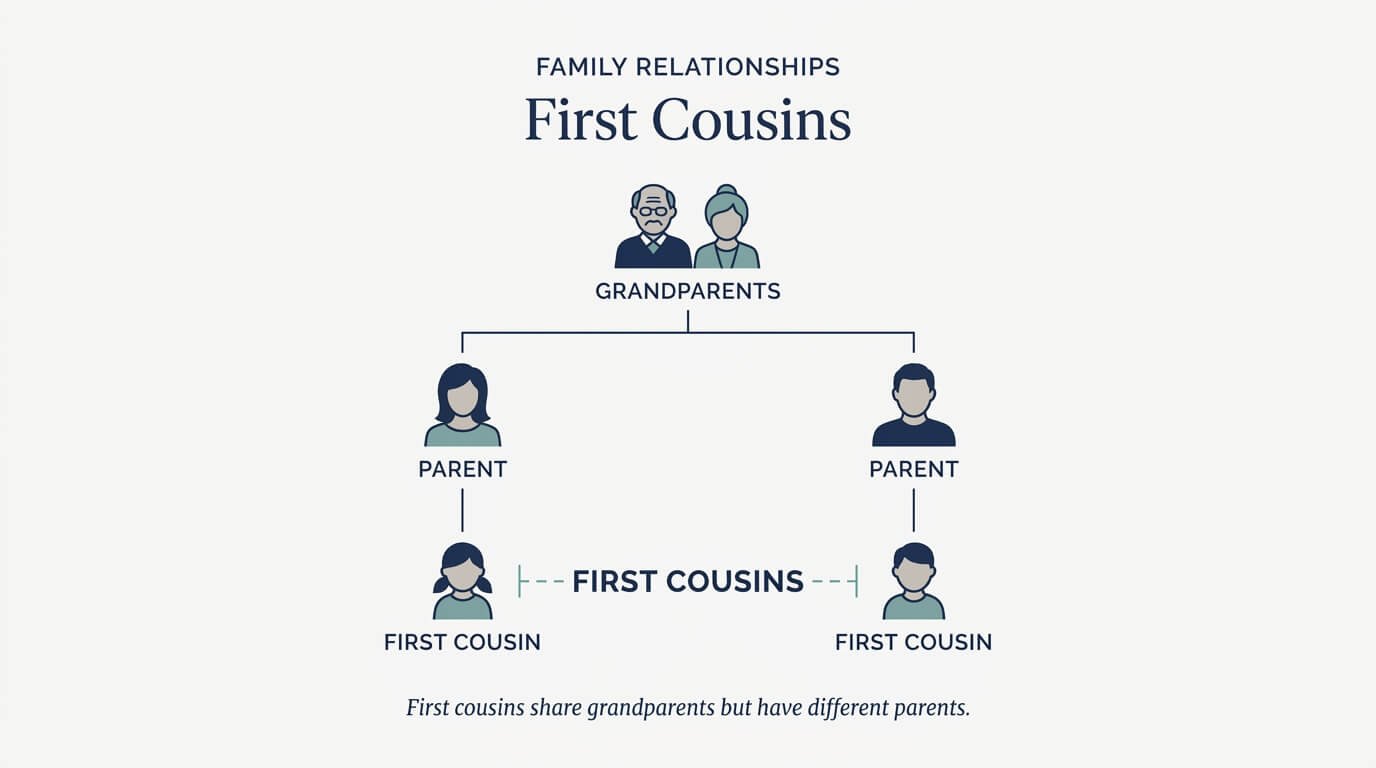
UK marriage law works by listing the relatives a person cannot marry, not by listing who they can. In England and Wales, section 1 and Schedule 1 of the Marriage Act 1949 make void any marriage between a person and their parent, child, grandparent, grandchild, sibling (including a half-sibling), parent’s sibling or sibling’s child, together with adoptive and former adoptive parents and children. Cousins appear nowhere on that list, so a marriage between first cousins is valid. The full list is in Schedule 1 of the Marriage Act 1949 on legislation.gov.uk.
A second, shorter list covers step-relatives and in-laws, such as a former spouse’s child. Those marriages are allowed only in limited circumstances, and the list has no bearing on cousins.
Both parties must be at least 18. The minimum age rose from 16 to 18 on 27 February 2023 under the Marriage and Civil Partnership (Minimum Age) Act 2022.
These restrictions apply equally when a couple registers a civil partnership instead of marrying, because the Civil Partnership Act 2004 uses a matching list of prohibited relationships.
Scotland and Northern Ireland use Separate Statutes with the Same Result
In Scotland, the forbidden degrees are set out in Schedule 1 of the Marriage (Scotland) Act 1977, as substituted in December 2014. The list covers a parent, child, grandparent, grandchild, sibling, aunt or uncle, niece or nephew, great-grandparent and great-grandchild, plus adoptive relationships. First cousins are not included. A marriage inside the list is void if it takes place in Scotland or if either party is domiciled there.
Northern Ireland has its own rules, found in Article 18 of the Family Law (Miscellaneous Provisions) (Northern Ireland) Order 1984, with Schedule 12 of the Civil Partnership Act 2004 covering civil partnerships. The civil partnership list corresponds to the marriage prohibitions and does not include cousins. A marriage between first cousins is therefore valid in all four nations of the UK.
Second cousins, half cousins and cousins once removed
Because the law lists the relatives who cannot marry, any relative who is not on the list can marry. Applying the England and Wales list to the relationships people search for most:
- Can marry: a first cousin, a second cousin, a third cousin, a half cousin (the child of a parent’s half-sibling) and a first cousin once removed (the child of a cousin).
- Cannot marry: a parent’s sibling (aunt or uncle), a sibling’s child (niece or nephew), a sibling or half-sibling, a grandparent or grandchild, a parent or child, and an adoptive parent or child.
A marriage between relatives on the prohibited list is void even when the couple did not know they were related. Scotland adds great-grandparents and great-grandchildren to its list, and the same cousin-level relationships are lawful there.
A Relationship between Adult Cousins is not a Criminal Offence
The criminal law on relatives is separate from the law on marriage, and it is narrower. Sections 64 and 65 of the Sexual Offences Act 2003 make it an offence for an adult to have sexual penetration with an adult relative, but only where the relative is a parent, grandparent, child, grandchild, brother, sister, half-brother, half-sister, uncle, aunt, nephew or niece. Cousins are not on that list.
A consensual relationship between adult cousins is therefore lawful, as is marriage. For the relatives who are on the list, the offence carries up to two years’ imprisonment on conviction on indictment under section 64(5).
Where the Proposed ban stands as of October 2026?
A ban has been proposed but has not become law. Richard Holden, the Conservative MP for Basildon and Billericay, introduced the Marriage (Prohibited Degrees of Relationship) Bill on 10 December 2024 under the Ten Minute Rule. The bill would prohibit first cousin marriage by amending the Marriage Act 1949. The UK Parliament bill page, last updated on 5 May 2026, lists it as a Private Members’ Bill from the 2024-26 session. It has had its first reading and has made no further progress.
Private Members’ Bills rarely pass without government time, and this one has not been given any. The bill was listed again for second reading in January 2026 but did not proceed. In the same month the Prime Minister, Sir Keir Starmer, told Parliament that the government had already taken its position on the bill. A Downing Street spokesman said the expert advice on the risks was clear but that the government had no plans to change the law. The Health Secretary, Wes Streeting, has called first cousin marriages high risk and unsafe, without backing the ban.
A Private Member’s Bill that does not pass lapses at the end of the parliamentary session, so any ban would have to be reintroduced or taken up by the government as its own legislation. Until that happens, first cousin marriage remains lawful.
What the Health Evidence Shows?
The main UK evidence comes from the Born in Bradford study, which followed about 13,500 babies born at Bradford Royal Infirmary between 2007 and 2011. A team led by Dr Eamonn Sheridan of the University of Leeds reported in The Lancet in 2013 that being born to parents who are blood relatives raised the risk of a congenital anomaly from about 3% to about 6%. The only other main risk factor they identified was an older mother, and deprivation did not explain the difference.
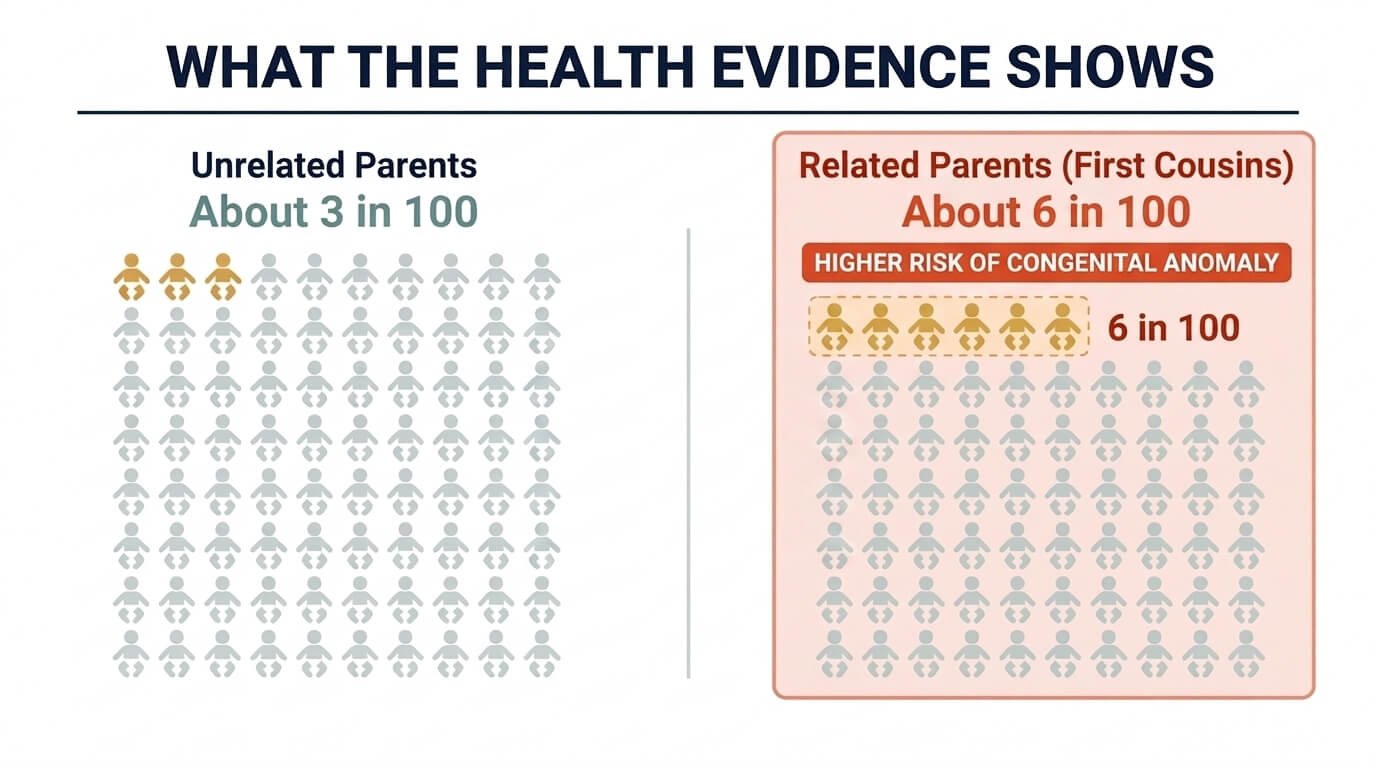
The researchers stressed that the absolute risk remains small and that the vast majority of babies born to couples who are blood relatives are healthy. They also noted that the figure can be higher in families where cousin marriage has been repeated across several generations.
An NHS England Genomics Education Programme article that described possible social benefits of first cousin marriage alongside the risks was taken down after Wes Streeting called for an apology. Genetic counselling is available through NHS clinical genetics services, and a couple can ask their GP about a referral.
How the UK compares with Norway and Sweden?
Norway and Sweden have taken the opposite route. Norway’s parliament amended its Marriage Act to ban cousin marriage in summer 2024. Sweden’s parliament voted in May 2026 to ban marriage between cousins and other close relatives, and the law took effect on 1 July 2026. Under the Swedish rules, cousin marriages contracted in another country are generally no longer recognised, and half-siblings and siblings through adoption can no longer be granted permission to marry.
The Swedish parliament gave the purpose as countering honour-based oppression, violence and other pressure connected with entering into marriage. Norway’s government also cited forced marriage. France, Spain and Belgium are among the European countries where first cousin marriage remains legal.
Cousin marriages abroad and forced marriage law
In general, a marriage celebrated abroad is recognised in the UK if it was valid under the law of the place where it took place and each party was free to marry under the law of their home country. A first cousin marriage that meets those tests is valid here, because first cousins are not within the UK’s prohibited degrees.
Forced marriage is a separate matter and a criminal offence whatever the relationship between the parties. GOV.UK states that forced marriage is illegal in England and Wales, including taking someone overseas to force them to marry, and that forcing someone to marry can lead to up to 7 years in prison. Any marriage involving someone under 18 is treated as a forced marriage, even without pressure. The Forced Marriage Unit (020 7008 0151) gives free advice to anyone being pressured into a marriage, and courts can make forced marriage protection orders. Scotland has its own forced marriage laws and support.
What happens if a marriage is void, and how a valid one ends?
A marriage between people within the prohibited degrees is void from the start. It is treated as never having been valid, and either party can ask the court for a nullity order. A first cousin marriage is valid, so it can only end through death or divorce.
In England and Wales, divorce no longer depends on proving fault. The grounds for divorce are now a single statement that the marriage has broken down irretrievably, a change that took effect on 6 April 2022 under the Divorce, Dissolution and Separation Act 2020. Scotland and Northern Ireland have their own divorce laws.
Quick Answers
Yes. First cousin marriage is legal in England, Wales, Scotland and Northern Ireland because first cousins do not appear on any of the lists of relatives who cannot marry. Both of you must be at least 18 and free to marry. As of October 2026, a proposed ban has not become law.
Yes to both. Second cousins and a cousin’s child (a first cousin once removed) are not on the prohibited lists anywhere in the UK, so a marriage between them is valid. A parent’s sibling and a sibling’s child are on the lists, so those marriages are void.
No. The offences of sex with an adult relative in sections 64 and 65 of the Sexual Offences Act 2003 cover parents, grandparents, children, grandchildren, siblings, half-siblings, uncles, aunts, nephews and nieces. Cousins are not covered, so a consensual relationship between adult cousins is not an offence according to UK law.
Not as of October 2026. The Marriage (Prohibited Degrees of Relationship) Bill, introduced in December 2024, has had its first reading only, and the government has said it has no plans to change the law. A ban would need Parliament to amend the Marriage Act 1949, either through a reintroduced Private Member’s Bill or through government legislation.
Yes. Scotland’s forbidden degrees are listed in Schedule 1 of the Marriage (Scotland) Act 1977, and Northern Ireland has its own rules under a 1984 Order. First cousins are not on either list, so the position matches England and Wales.
It is not a legal requirement, and nothing in the Marriage Act 1949 requires genetic testing before a marriage. The Born in Bradford study found the risk of a congenital anomaly rising from about 3% to about 6% for children of related parents, although the vast majority of babies are born healthy. You can ask your GP about a referral to an NHS clinical genetics service.
In general, yes. A marriage that was valid where it took place, and where both of you were free to marry under the law of your home country, is recognised in the UK. First cousins are not within the UK’s prohibited degrees, so the relationship itself does not stop the marriage being recognised.