

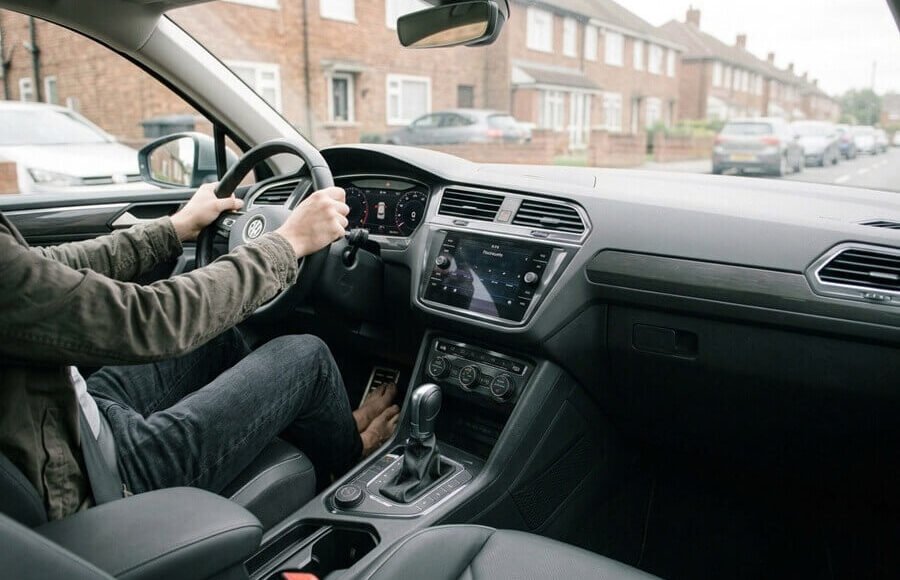
Driving barefoot is legal in the UK. No Act of Parliament or regulation requires drivers to wear shoes, and the same applies to socks, slippers and flip-flops. The law does require that you have proper control of your vehicle, and that is where bare feet can cause a problem.
Driving barefoot is not an offence in the UK, but the law asks whether you had proper control of the vehicle, and bare feet can count against you if control is lost.
This article explains what the Highway Code says about footwear, which offences apply when footwear affects control, what the penalties are as of October 2026, and where insurance fits in.
Why there is no law against driving barefoot?
UK road traffic law regulates how a vehicle is driven, not what the driver wears on their feet. No statute or regulation mentions bare feet, socks, slippers or flip-flops, so driving barefoot is lawful in the same way that driving in trainers is lawful.
The Driving Standards Agency, now part of the DVSA, has said it does not recommend driving barefoot because bare feet do not give the same braking force as shoes. That is road safety advice and carries no legal force.
Every legal consequence of barefoot driving comes back to one question: whether the driver was in control. If your feet stay on the pedals and your driving meets the standard of a careful driver, your lack of footwear is irrelevant to the law. If a foot slips off a pedal and a collision follows, it can become relevant.
What Highway code rule 97 says about footwear?
Rule 97 lists the checks a driver should make before setting off. One of them is that clothing and footwear do not prevent you using the controls in the correct manner. The rule sits in the “should” list, not the “must” list, so it is advice and not a legal requirement. The full text is in the Highway Code rules for drivers and motorcyclists on GOV.UK.
Section 38(7) of the Road Traffic Act 1988 explains what that means in practice. A failure to observe a provision of the Highway Code does not of itself make anyone liable to criminal proceedings, but it can be relied on by any party in civil or criminal proceedings as tending to establish or negate liability. A driver who ignores rule 97 has not committed an offence by doing so. If the driver’s footwear contributed to a collision, though, the prosecution in a criminal case or the other party in a civil claim can point to the rule.
Two figures that circulate online about rule 97 are not in it. The Highway Code does not say you can be fined £5,000 for wearing flip-flops, and it sets no sole thickness. The 10mm figure comes from RAC guidance, which advises a sole no thicker than 10mm.
When bare feet become a legal problem?
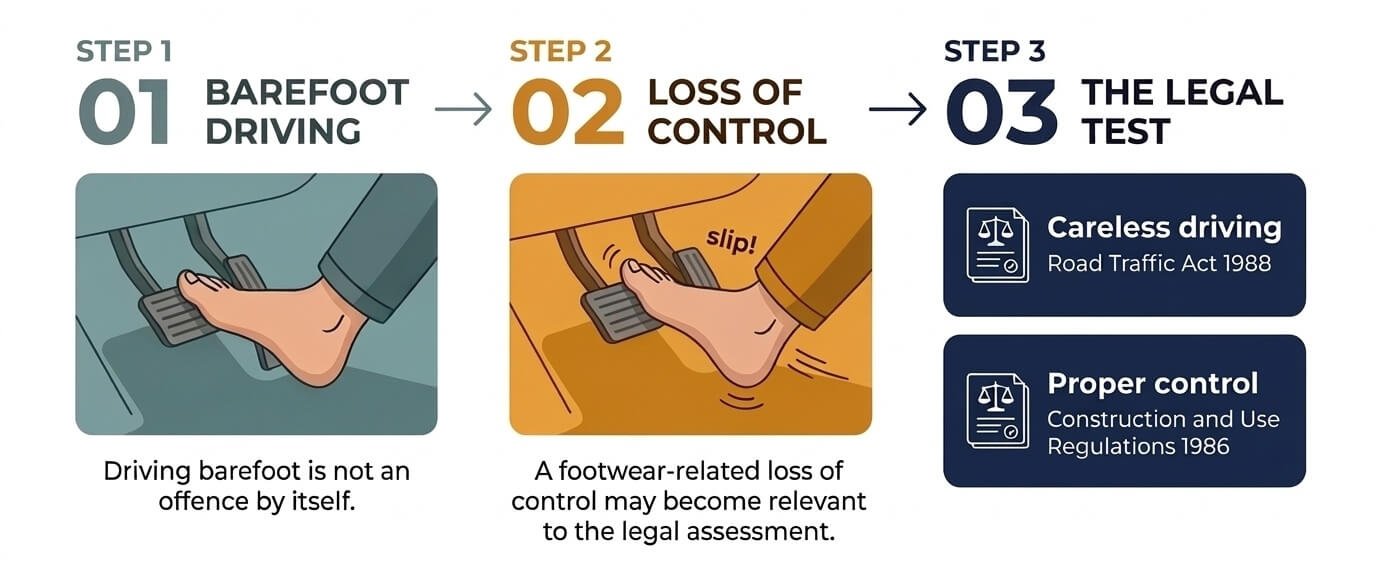
Two provisions apply when footwear, or the lack of it, affects how a person drives.
The first is careless driving. Section 3 of the Road Traffic Act 1988 makes it an offence to drive a mechanically propelled vehicle on a road or other public place without due care and attention, or without reasonable consideration for other people using the road. A driver whose wet bare foot slips off the brake, and who then hits the car in front, could be charged under this section. The offence turns on driving below the standard of a careful driver, and the footwear is only part of the explanation for why that happened.
The second is regulation 104 of the Road Vehicles (Construction and Use) Regulations 1986, headed “Driver’s control”. It prohibits driving a motor vehicle on a road if the driver is in such a position that they cannot have proper control of the vehicle or a full view of the road and traffic ahead. The regulation is worded around the driver’s position, and the test it applies, proper control, is the same test that matters for footwear.
In minor cases careless driving is dealt with by a fixed penalty notice of £100 and three penalty points, a level set when police gained the power to issue fixed penalties for the offence in August 2013. If the case goes to court, the penalties are a fine of up to £5,000 and between three and nine penalty points, with disqualification possible in serious cases. In Northern Ireland, nidirect lists the same fine and points ranges for careless driving.
Those points matter more when the licence already carries others, because reaching 12 points within three years usually means a ban under the totting-up rules. Even an MS90 offence for failing to name the driver when asked carries six penalty points.
Neither provision mentions footwear. Barefoot driving is never an offence by itself, and a prosecution depends on proof that the driver fell below the standard of a careful driver or lacked proper control. That is why the £5,000 figure quoted in many footwear articles describes the court maximum for careless driving in general. It does not describe a penalty for driving without shoes.
Flip-flops, socks, slippers and heels
The same legal test applies to every type of footwear. None is banned, and the question is always whether the driver could control the vehicle. How each type tends to affect control:
- Flip-flops and sandals: they can slip off the foot or become wedged under a pedal, and the RAC has said light, flimsy footwear can be dangerous.
- Socks and slippers: they give little grip, and open-backed slippers can slip off the foot when you use the pedals.
- Heels: a thin heel can catch under a pedal or in the floor mat.
- Walking boots and snow boots: the RAC has said sturdy shoes can also be unsuitable, because a thick sole reduces how well you can feel and control the pedals.
The RAC’s guidance on suitable driving shoes is that the sole should be no thicker than 10mm but not too thin or soft, the shoe should grip enough to stop the foot slipping off the pedals, it should not be heavy or restrict ankle movement, and it should be narrow enough not to press two pedals at once. Wet or sandy feet, for example after a trip to the beach, are also more likely to slip on a pedal.
Does driving barefoot affect your insurance?
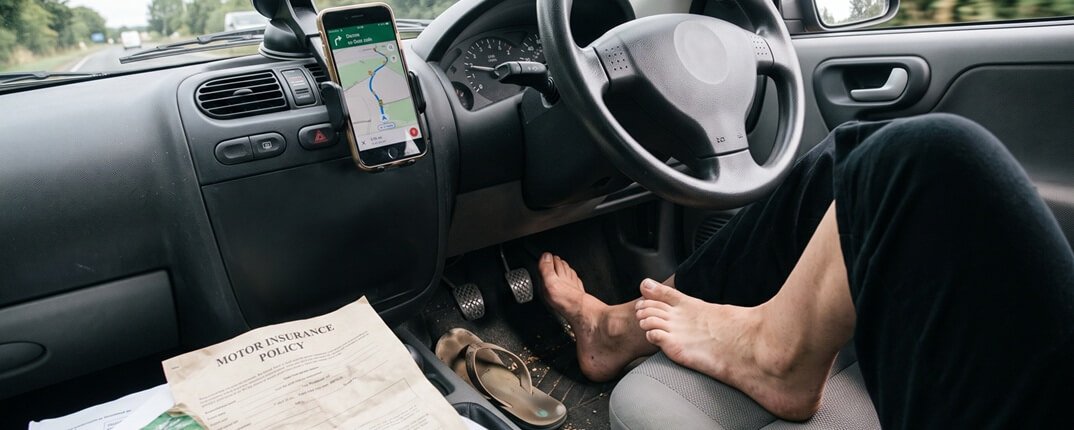
No statute or Highway Code rule invalidates motor insurance because of footwear. Whether a claim is affected depends on the policy wording and on whether the footwear contributed to the accident, so a driver who wants certainty should check the policy or ask the insurer.
Insurers do see footwear in claims. Allianz UK said in a press release dated 23 July 2026 that it had paid about £277,000 in claims involving flip-flops and sandals since 2021, at an average of £4,250 a claim, mostly low-speed collisions such as crashes into walls, other vehicles and incidents in car parks. The same release cited a survey of 2,000 UK car owners, commissioned by Allianz, in which one in five said they had driven barefoot.
Footwear can also matter in a civil claim. Under the Law Reform (Contributory Negligence) Act 1945, a court can reduce compensation to reflect a claimant’s own share of the fault for the damage they suffered. If a barefoot driver is injured in a collision and claims against another driver, the other side could argue that the lack of footwear contributed to the loss of control and ask for a reduction, relying on rule 97 as section 38(7) of the Road Traffic Act 1988 allows.
Any claim also carries a cost to the claimant, because the court fee depends on the amount claimed, and you can calculate the court fee before you start