
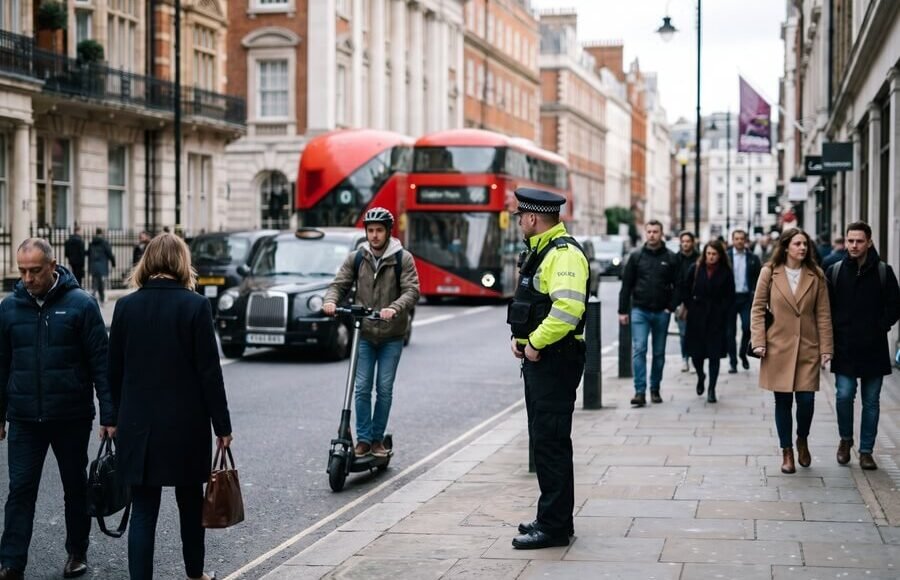
Yes and no. You can buy and own a private electric scooter, but you cannot lawfully ride it on a public road, cycle lane or pavement. The only e-scooters that can legally be used on public roads are rental scooters in government trial areas. This article covers England and Wales.
Why a Private E-Scooter Is Illegal on the Road?
An e-scooter is treated as a motor vehicle under the Road Traffic Act 1988. According to Policing.uk, that means a rider needs a driving licence and insurance, and the scooter must meet construction requirements for road vehicles.
In practice, a private e-scooter cannot meet those rules. Policing.uk says no manufacturer currently meets UK road-use standards for them, and Browne Jacobson says no mainstream motor insurance product exists for private e-scooters. GOV.UK puts it simply: “It is against the law to use a privately owned electric scooter on public land.”
The offence is about using one, so the speed, size or price of your scooter does not change the position.
Rental E-Scooter Trials
Rental e-scooters in official trial areas are the only lawful way to ride one on a public road. The trials began in 2020 and are due to end in May 2028. The Department for Transport announced the latest extension on 21 July 2025, according to Road Safety GB.
The rules for riders, from GOV.UK, are:
- You need a provisional or full UK driving licence with category Q entitlement. Some overseas full licences qualify, but overseas provisional licences do not
- You can ride on roads (not motorways) and cycle lanes within an official trial area, and on cycle ways marked with the recommended route sign unless a separate sign prohibits e-scooters
- You cannot ride on the pavement
- Only one person can ride at a time, and towing is not allowed
- The top speed is 15.5mph, and some areas set a lower limit
- A cycle helmet is advised but not legally required
- You cannot ride while drunk or intoxicated, and you cannot use a phone while riding, except for a navigation screen set up before you set off
GOV.UK says operators must provide at least third-party insurance for the rental scooter. Check the operator’s own terms before you hire one.
Can You Ride a Private E-Scooter on Private Land?
Yes, with the landowner’s permission. Policing.uk says road traffic law applies to roads and other public places, not private land, so riding on your own land or on land where the owner has agreed is not the same offence. Make sure you have the owner’s permission, and if the land is open to the public, check before you ride.
Private and Rental E-Scooters
| Private e-scooter | Rental e-scooter (trial area) | |
|---|---|---|
| Public roads | Illegal | Allowed, except motorways |
| Cycle lanes | Illegal | Allowed |
| Pavements | Illegal | Illegal |
| Licence needed | Not lawful on the road whatever licence you hold | Provisional or full UK licence with category Q |
| Insurance | Cannot be insured in practice | Provided by the operator |
| Private land | Allowed with permission | Not applicable |
Penalties for Riding a Private E-Scooter
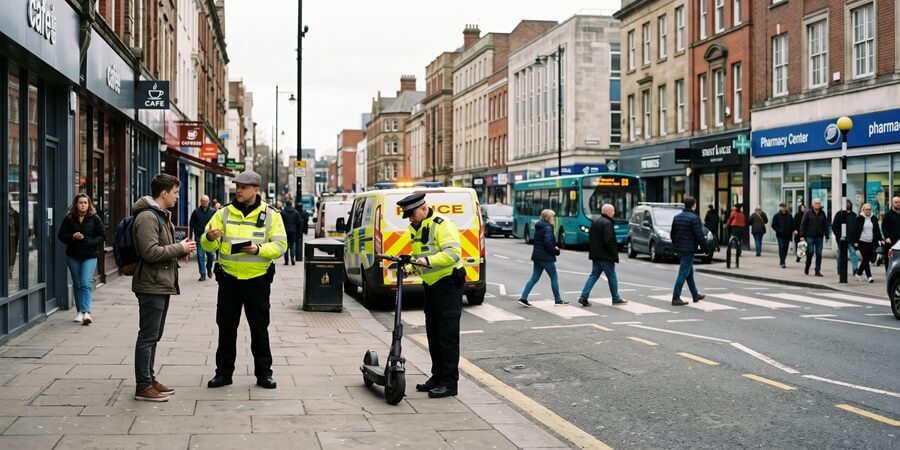
GOV.UK says penalties for using a private e-scooter on public land include a fine, penalty points on your licence and impoundment of the scooter. Policing.uk sets out the offences:
- Driving without a valid licence (section 87 of the Road Traffic Act 1988): up to 6 penalty points and a fine
- Using without third-party insurance (section 143): 6 to 8 penalty points, an unlimited fine and possible disqualification
- Riding on a footway (section 72 of the Highways Act 1835): a fixed penalty notice
You can be charged with more than one of these for the same ride.
What Happens If Police Stop You?
Police can seize a private e-scooter. Policing.uk says a seized scooter may be destroyed if it cannot be made road-legal, and that release usually requires a fee and proof of insurance, which it says is rarely possible for private e-scooters. That means a seized scooter is unlikely to come back.
If you have to deal with police after a seizure, keep any paperwork they give you and ask what you need to do to get it back.
Can You Insure an E-Scooter?
Not a private one, for road use. Browne Jacobson says no mainstream motor insurance product exists for private e-scooters.
That matters if you are the person who gets hurt. The Motor Insurers’ Bureau compensates third parties injured by uninsured riders and is funded by a levy on motor insurers, and Browne Jacobson says it paid almost £47 million on micromobility claims in 2025. If you are hurt by an uninsured e-scooter rider, compensation can come from the Motor Insurers’ Bureau, and motor legal protection on your own car policy can help with uninsured losses where the accident was not your fault.
Buying an E-Scooter
GOV.UK describes the offence as using a private e-scooter on public land, not owning one. Before you buy one, ask yourself where you will ride it, because the answer decides whether you can use it lawfully at all.
When Might Private E-Scooters Become Legal?
Not yet, and there is no date. The King’s Speech on 18 May 2026 made no mention of e-scooter legislation, according to Road Safety GB. The roads minister said the government “remains committed to regulating micromobility vehicles”, and the government plans to consult on detailed proposals over the next year and aims to bring in a permanent solution during this Parliament.
That is a plan, not a law. Until new legislation is passed, the current rules apply. Check GOV.UK before relying on this, as the position could change.
Common Misunderstandings
“It only goes 15.5mph, so it is allowed.”
The 15.5mph limit is part of the rental trial rules. It does not make a private e-scooter legal.
“I’ll only ride on the pavement.”
It is still an offence. Pavements are off limits for rental e-scooters too, and Policing.uk lists riding on a footway as a separate offence.
“A helmet makes it legal.”
No. Helmets are advised in the rental trials, but they do not change the law on private e-scooters.
“It is my own scooter, so I can ride it anywhere.”
You can ride it on private land with permission. You cannot ride it on public roads, cycle lanes or pavements.