


On 6 April 2026, unlimited inheritance tax relief on farms and business assets came to an end. Estates now get a £2.5 million allowance for 100% relief, with anything above that taxed at an effective rate of 20%.
Quick Info
- What changed: 100% relief on farm and business assets is capped for the first time, ending decades of unlimited relief
- The threshold: £2.5 million per person, increased from a proposed £1 million after industry pressure, confirmed 23 December 2025
- Tax rate above the threshold: 20% effective rate (50% relief on the excess)
- Couples: unused allowance transfers between spouses and civil partners, giving up to £5 million combined before nil-rate bands are even added
- Took effect: 6 April 2026, under the Finance Act 2026
This is a genuine estate planning conversation, not just a tax rate change, since the gifting rules, trust timing, and payment options that surround it all shifted at the same time.
What Actually Changed?
Until now, farms and qualifying business assets could pass to the next generation entirely free of inheritance tax, regardless of value, under Agricultural Property Relief (APR) and Business Property Relief (BPR). That unlimited relief ended from 6 April 2026. The government originally proposed capping 100% relief at £1 million per person, a figure the Country Land and Business Association warned could affect around 70,000 farms. Following sustained lobbying, the government revised this twice: first confirming in the Autumn Budget 2025 that the allowance would be transferable between spouses, then, in a announcement on 23 December 2025, raising the cap itself from £1 million to £2.5 million. For any estate going through this process, settling the inheritance tax position isn’t a side step, it’s generally a precondition: HMRC’s confirmation is what allows the Probate Registry to issue a grant of representation in the first place, so the tax calculation now sits earlier in the administration timeline than many executors expect.
How the New £2.5 Million Allowance Actually Works?
The mechanics are more specific than a single headline figure suggests:
- The first £2.5 million of combined qualifying agricultural and business property receives 100% relief, meaning no inheritance tax at all
- Value above £2.5 million receives 50% relief, working out to an effective 20% inheritance tax rate on the excess, confirmed in GOV.UK’s published guidance on the APR and BPR reform
- The allowance refreshes every 7 years for individuals, and every 10 years for trusts
- Transfers made before Budget day, 30 October 2024, aren’t affected by the new rules at all
Let’s Clear the £5 Million vs £5.65 Million Confusion
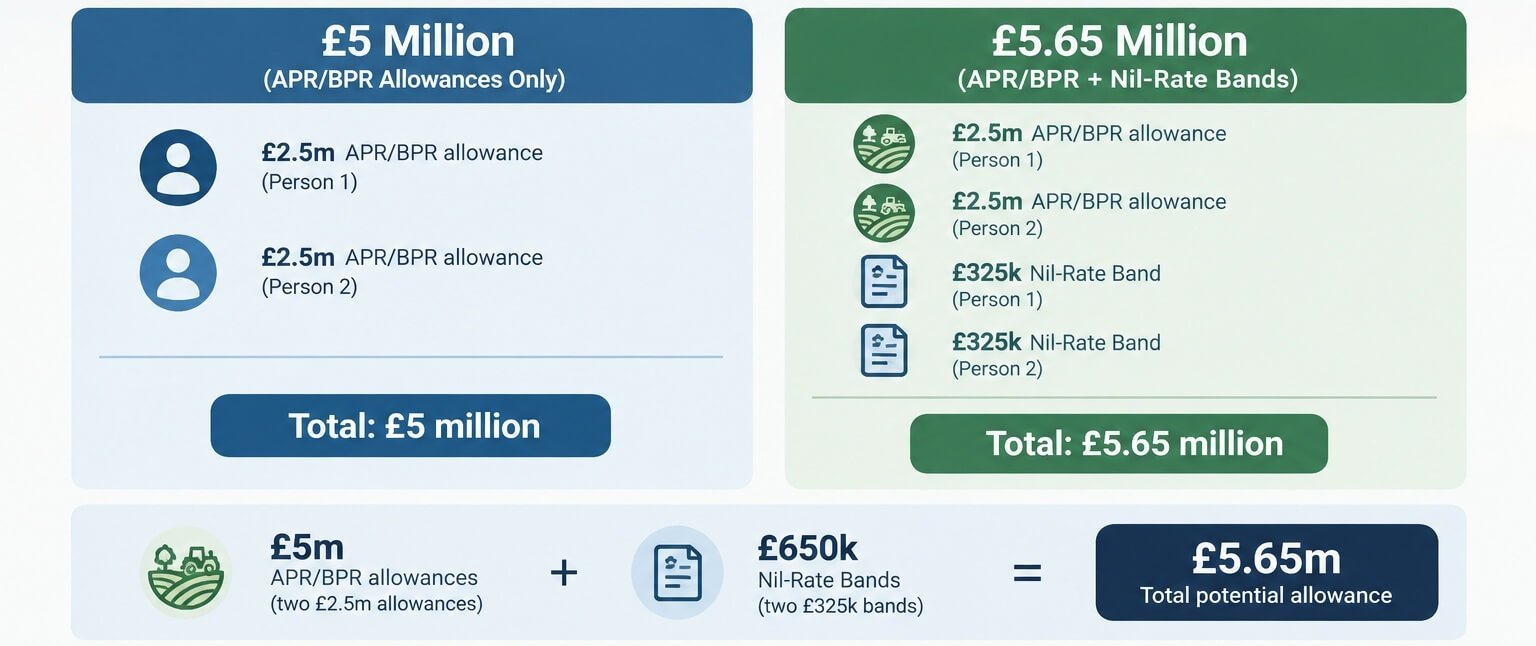
Different sources quote different combined figures for couples, and both are technically correct, they’re just answering slightly different questions. £5 million is simply two £2.5 million APR/BPR allowances added together, one per spouse or civil partner, assuming the full allowance transfers on first death. £5.65 million includes that £5 million plus two £325,000 nil-rate bands on top, the standard inheritance tax allowance that exists separately from APR and BPR altogether. Which figure actually applies to a given estate depends on whether the nil-rate bands are still available, since they can already be used up by other assets outside the farm or business.
Lifetime Gifting
This is worth understanding properly rather than treating as a single line item. Gifting farm or business assets during your lifetime, known as a Potentially Exempt Transfer, can remove that value from your estate for inheritance tax purposes, but only if you survive seven years from the date of the gift. Die within that window and the gift can still be brought back into the estate’s value, on a sliding scale of relief called taper relief for gifts made between three and seven years before death.
There’s a further trap worth knowing about. If you gift an asset but continue to benefit from it, still living in the farmhouse you’ve gifted, for instance, HMRC can treat it as a “gift with reservation of benefit,” meaning it’s still counted as part of your estate regardless of how many years have passed. And gifting can trigger capital gains tax in its own right, separate from inheritance tax entirely, though this can often be deferred for qualifying business assets using holdover relief.
The Trust Cap That Took Effect on 6 April 2026
Anyone who placed land or business assets into a lifetime trust before 6 April 2026 did so under the old rules, with no cap on the value that could be gifted without an immediate tax charge. That window has now closed. Since 6 April 2026, an effective limit applies to trust transfers, in line with the same £2.5 million allowance structure. If you’re only now considering this route, the unrestricted option that existed before that date is no longer available, and any new trust planning has to work within the capped structure going forward.
You Don’t Have to Pay it All at Once
A genuinely reassuring detail that gets little coverage: inheritance tax on qualifying APR and BPR property can be paid in instalments over 10 years, interest-free. This matters enormously for farming estates specifically, where the wealth is tied up in land and equipment rather than cash, since it removes much of the pressure toward a forced sale just to cover a tax bill.
What’s Coming Next: Pensions From April 2027
Worth having on your radar while planning around this change. From April 2027, most defined contribution pensions will be brought into the value of your estate for inheritance tax purposes, a shift from the current position where pensions generally sit outside your estate entirely, as set out in the House of Commons Library’s briefing on the reforms. For farming families already restructuring around the APR/BPR changes, it’s worth factoring this second, related shift into the same conversation rather than treating it separately a year later.
Let’s Understand with Example
A farming couple own qualifying assets worth £4 million between them, held jointly. Under the new rules, if the full estate passed to the survivor on first death, no inheritance tax would be due at that point, transfers between spouses remain exempt regardless of the APR/BPR cap, and because the assets were held jointly, this is often exactly the situation where when is probate not required actually applies, since jointly owned property can pass automatically without a grant. On the second death, assuming both £2.5 million allowances are available, £5 million of the £4 million estate would be covered entirely by the combined APR/BPR allowance, meaning no inheritance tax would actually be due in this specific scenario. Where estates exceed the combined allowance is where the 20% effective rate starts to bite, which is why getting an accurate, current valuation matters considerably more than it used to.
What to Do Now
- Get an accurate, current valuation of all qualifying agricultural and business assets
- Review your will with the £2.5 million allowance specifically in mind, older wills may not make the best use of it
- If lifetime gifting or trust structures interest you, get advice on how they work under the current capped rules, the unrestricted trust option that existed before 6 April 2026 is no longer available
- Ask about the 10-year instalment option if cashflow is a concern rather than assuming the bill has to be paid upfront
Quick Answers
No, transfers made before 30 October 2024 are entirely unaffected, and transfers between that date and 6 April 2026 fall under separate transitional rules rather than the new regime.
This is likely to be treated as a “gift with reservation of benefit,” meaning HMRC can still count the asset as part of your estate for inheritance tax purposes, regardless of how many years have passed since the gift.
Per person, £2.5 million each, though any unused portion transfers to a surviving spouse or civil partner, which is what allows a couple to shelter up to £5 million combined.