

Things to Know
PAT testing itself is not named as a legal requirement anywhere in UK law. What is a legal requirement is that employers, the self-employed and other dutyholders keep electrical equipment maintained so that it doesn’t cause danger, under regulation 4 of the Electricity at Work Regulations 1989 and the general duties in the Health and Safety at Work Act 1974. PAT testing is simply the most widely recognised way of demonstrating that duty is being met. There’s no fixed legal interval for how often it must happen; that depends on a risk assessment of the equipment, its environment and how it’s used.
Search “is PAT testing a legal requirement” and you’ll find a genuinely confusing answer sitting underneath a simple question. The short version is no, not by that name, but the duty behind it very much is, and getting that distinction wrong is what causes most of the confusion around how often testing is actually needed.
No UK law uses the words “PAT testing,” but several laws require the outcome PAT testing is designed to prove.
Below is what actually creates the legal duty, why treating PAT testing as optional is riskier than the “not legally required” headline suggests, how often it should realistically happen, and where landlords sit differently from employers.
What PAT Testing Actually Checks
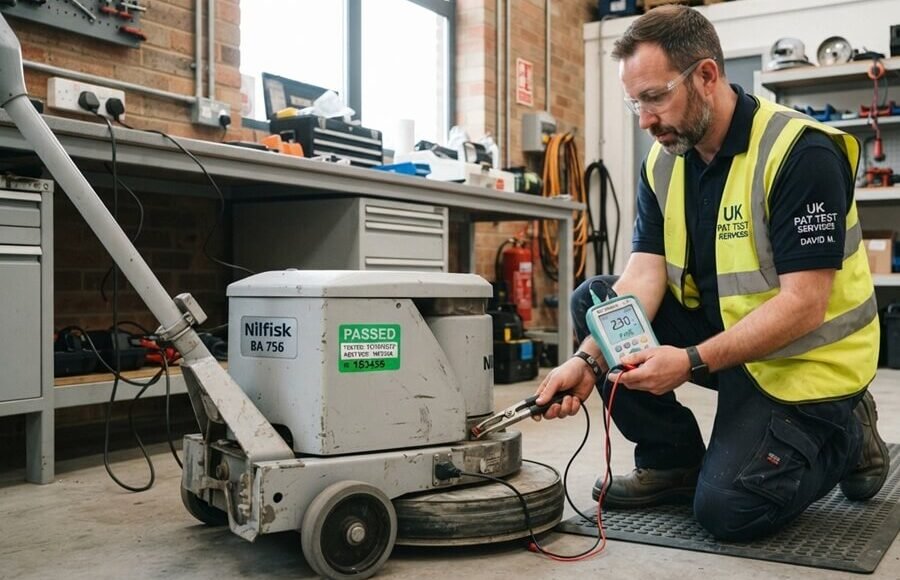
Portable Appliance Testing covers a combination of a visual inspection and, where appropriate, electrical tests such as earth continuity, insulation resistance and polarity checks, carried out on plug-in electrical equipment. It’s designed to catch faults that aren’t visible from the outside, things like internal wiring damage or insulation breakdown, that a visual check alone wouldn’t identify.
Ongoing maintenance still matters alongside it, including routine user checks and periodic formal visual inspections carried out between formal tests.
The Law That Actually Applies
No single piece of legislation names PAT testing directly. What creates the underlying duty is a combination of several regulations:
- The Electricity at Work Regulations 1989, specifically regulation 4(2), which requires that electrical systems be maintained so far as is reasonably practicable to prevent danger. This is the regulation most directly relevant to electrical safety specifically, and it applies to every workplace.
- The Health and Safety at Work Act 1974, which sets the general duty on employers to ensure, so far as reasonably practicable, the health and safety of employees and anyone else affected by their work, including through safe equipment.
- The Provision and Use of Work Equipment Regulations 1998 (PUWER), which requires work equipment generally to be suitable for its purpose and properly maintained. It’s a broader equipment regulation rather than one written for electrical safety specifically, but it reinforces the same underlying obligation.
None of these say “test every appliance annually.” They say equipment must be safe and properly maintained, and leave the method of proving that to the dutyholder. PAT testing is simply the method the Health and Safety Executive and the industry’s own Code of Practice recognise as the standard way of doing that.
Why “Not Required” Doesn’t Mean Optional
The absence of a named legal requirement doesn’t remove the underlying duty to keep equipment safe, and failing to demonstrate that duty has real consequences. The Health and Safety Executive can issue improvement or prohibition notices, and breaches of the Health and Safety at Work Act can carry unlimited fines in the Magistrates’ Court, with custodial sentences possible in the most serious cases. Beyond formal enforcement, insurers commonly decline claims involving an electrical fire or shock where the policyholder can’t show evidence of a reasonable maintenance system, and an injured employee, customer or tenant can bring a separate civil claim for damages regardless of any regulatory action.
In practice, that means PAT testing functions as a legal requirement even though no statute names it as one. It’s the evidence a dutyholder points to when asked to show the underlying duty has been met.
How Often Equipment Should Actually Be Tested?
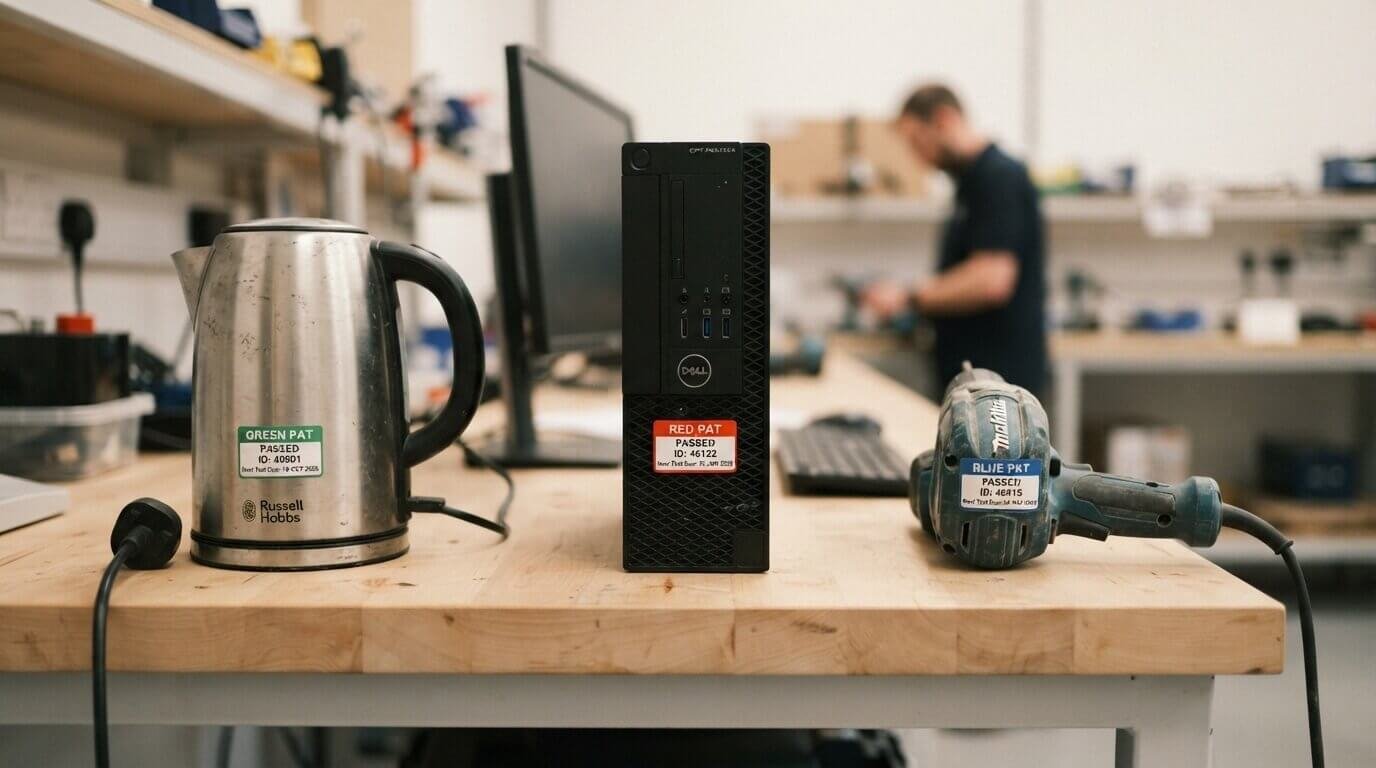
There’s no single interval that applies to every appliance, and the regulations deliberately don’t set one. The right frequency depends on the equipment itself (its age, condition and manufacturer guidance), how and where it’s used (a laptop charger in an office carries far less risk than a power tool on a construction site), how often it’s moved or subject to wear, and the results of previous tests.
The Institution of Engineering and Technology’s Code of Practice for In-Service Inspection and Testing of Electrical Equipment is the recognised industry reference for setting a sensible schedule based on these factors, and it’s treated by the HSE, insurers and the courts as the practical standard, even though it isn’t itself a piece of legislation. Earlier editions of the Code published a table of suggested starting intervals, and although the current edition replaced that fixed table with a risk-assessment approach, the old figures are still widely used across the industry as a sensible baseline: something in the region of three months for handheld equipment on a construction site, stretching out to several years for static IT equipment in a low-risk office. The HSE’s own guidance leaflet, INDG236, makes the same point in simpler terms: testing frequency should be based on risk, not a calendar.
Landlords and Rented Property
This is where the legal position genuinely does differ depending on what’s being tested. Fixed wiring in privately rented property in England must be inspected and tested at least every five years under the Electrical Safety Standards in the Private Rented Sector (England) Regulations 2020, producing what’s known as an EICR. That’s a hard legal requirement with a fixed interval, unlike the position for workplace equipment generally.
Portable appliances supplied to tenants, kettles, ovens, washing machines and similar, have historically had no equivalent fixed legal requirement in the private rented sector, and that’s still the position for private landlords: government guidance recommends checking any appliances provided, but there’s no statutory obligation to PAT test them on a set schedule.
That’s changed for the social rented sector specifically. The Electrical Safety Standards in the Private Rented Sector (England) Regulations 2020 were extended in 2025 to cover social housing too, and the amending regulations go further than the original private-sector rules: social landlords who supply electrical equipment to tenants must now have that equipment tested, not just the fixed wiring. The regulations came into force on 1 November 2025, applying to new social tenancies granted from 1 December 2025 and to existing tenancies from 1 May 2026. Private landlords aren’t covered by that specific equipment-testing duty, only social landlords are, which is a distinction worth being precise about rather than treating “landlord” as one uniform category.
Awaab’s Law, which began applying to the social rented sector in England from October 2025 covering emergency hazards and serious damp and mould, is due to expand further from 30 November 2026 to include fire and electrical hazards. That’s a separate piece of regulation from the equipment-testing extension above, but it adds to the same overall picture: social landlords are being brought under considerably tighter electrical safety duties than private landlords currently face.
Who Can Carry Out PAT Testing?
The person carrying out testing needs to be competent, meaning they have the knowledge, training and experience for the task, or are working under appropriate supervision. That doesn’t have to mean a qualified electrician for straightforward portable equipment, and reducing competence to a job title misses the point of the requirement. What matters is whether the person understands what they’re testing, can select the right tests, and can correctly interpret the results.
What Happens If You Don’t?
Beyond the enforcement and insurance risks already covered, many commercial contracts, local authority licences and landlord obligations to letting agents specify a current PAT certificate as a condition, regardless of what the underlying law strictly requires. Falling behind on testing can therefore cost a business or landlord contracts and licences even before any incident or inspection brings the legal duty into play directly.
Quick Answers
Not as a fixed legal requirement in the way an EICR is required for rented property. The same underlying duty to keep equipment safe still applies if you employ anyone or have visitors, but there’s no set testing schedule mandated by law.
Yes, provided you’re competent to carry it out, meaning you understand the equipment, the correct tests to use and how to interpret the results. It doesn’t legally have to be an outsourced electrician for straightforward equipment.
An EICR (Electrical Installation Condition Report) covers the fixed wiring and electrical installation of a building, and is a genuine fixed legal requirement in the private rented sector. PAT testing covers portable, plug-in appliances and has no equivalent fixed statutory interval.
It depends which sector. Private landlords have no specific legal requirement, though government guidance recommends it. Social landlords are different: since the 2025 extension of the Electrical Safety Standards regulations to the social rented sector, they must test electrical equipment they supply to tenants, phased in from November 2025 for new tenancies and May 2026 for existing ones.