
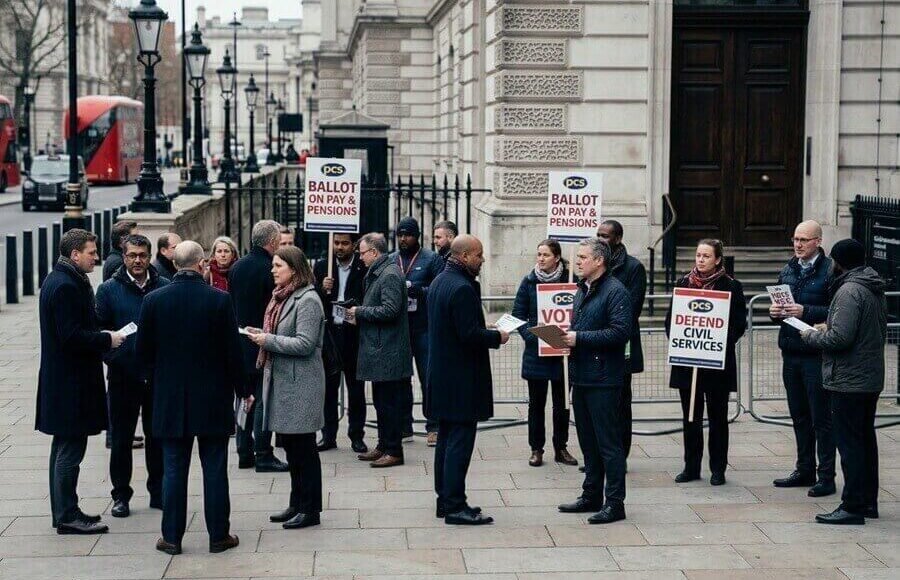
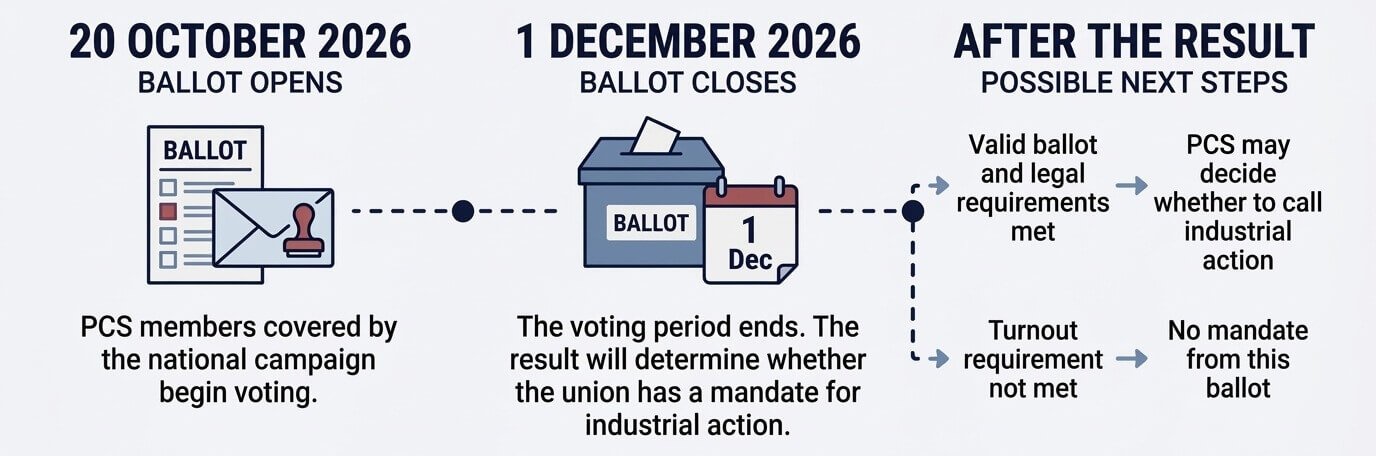
The Public and Commercial Services union (PCS) will ballot its civil service members on strike action and action short of strike from 20 October to 1 December 2026. No strike dates have been set, and none can be until the ballot closes and the union gives notice.
PCS members across 138 employers will vote from 20 October to 1 December 2026 in a dispute over pay, job security, pensions and terms and conditions, and any strike would need a valid ballot result, with turnout above 50%, and at least 10 days’ notice.
What PCS Is Asking For
The union’s headline demand is a fully funded 10% pay rise. The Civil Service Pay Remit for 2026/27 sets a headline increase of 3.5%, which PCS says falls far short of what members need and which it has told the government it rejects.
The other demands reported by Civil Service World and IBTimes UK are:
- Pay restoration and a minimum of £18 an hour for the lowest paid
- Progress toward a shorter working week without loss of pay
- Greater protection against compulsory redundancy and better job security
- Better pensions, flexible working, annual leave and sick pay
- A right to disconnect outside working hours
- Consultation before artificial intelligence or robotics are introduced
The four-day week is the most contested demand. The coverage distinguishes it from compressed hours, which keep the weekly total the same, and critics have urged ministers to oppose a full-pay shorter week.
What the Government Has Said
A Cabinet Office spokesperson told Civil Service World that the government is committed to recognising the hard work of civil servants while ensuring public sector pay remains sustainable, and that discussions will continue with civil service unions including PCS. The reports do not describe any new pay offer.
How the Ballot Works
A ballot is a vote on whether to take action. It does not start a strike by itself. PCS says it has served dispute and ballot notices on all 138 employers covered by its national campaign, and only PCS members at those employers can vote. After the ballot closes on 1 December, PCS’s national executive will consider the result and decide whether to call action and when.
Several rules shape what happens next. Some changed in 2026 under the Employment Rights Act 2025:
- Voting method: PCS says the ballot will combine electronic, online voting and postal voting, which the Employment Rights Act 2025 reforms now allow.
- Turnout: the 50% turnout requirement for strike ballots still applies. PCS’s own ballot FAQ says a legal mandate needs turnout above 50% before action can go ahead, because the planned repeal of the threshold has not yet been enacted. Personnel Today reported on 3 August 2026 that unions were still asking for its repeal and that no date had been given. A ballot can fail on turnout even if most of those who vote back action.
- Support threshold: the separate 40% support threshold for important public services was removed on 18 February 2026, according to law firm VWV’s summary of the changes.
- Notice: unions must now give employers 10 days’ notice of industrial action, down from 14 days, from 18 February 2026.
- Mandate: a ballot opened on or after 18 February 2026 gives a mandate that lasts 12 months, not six.
Together, these mean the earliest any strike could start is 10 days after PCS gives notice, and notice cannot be given on this ballot before it closes on 1 December.
What Could Happen in the Dispute
If the ballot meets the legal tests, PCS could call strikes, action short of strike such as a work to rule, or both. The 12-month mandate would give it a longer window to time action than the old six-month limit allowed. If turnout falls short, the ballot does not authorise action, and the union would have to reballot.
Talks could also settle the dispute before any action. Pay in the civil service is set department by department within the national remit, and PCS has said it will consult members on any offer based on the 3.5% remit.
Which public services would feel any action depends on which employers and which staff take part. PCS has announced no dates, so there is no confirmed effect on benefits, tax, passports or other services yet.
What Taking Part Means for Pay and Job Protection
Strikers lose pay for the time they are out. GOV.UK says employers do not have to pay staff on strike and can withhold pay only for the period covering the action, matching what the employee would have earned in that time. Pay cannot be deducted for days the employee was not due to work.
Action short of a strike, such as refusing part of the contracted duties, is treated differently. An employer that refuses to accept partial performance can withhold pay, while one that accepts it must pay for the work done.
On job security, dismissing someone for taking part in protected industrial action is automatically unfair, and since 18 February 2026 the old 12-week cap on that protection no longer applies, according to Pinsent Masons. The change covers employees whose participation began on or after that date, and only where the action is protected, meaning the ballot, notice and scope requirements have been met. Action that falls outside those rules does not carry the protection.