
The small claims court is the simplest way to claim up to £10,000 from a person or business in England and Wales. You start a claim online or by post, and the other side has 14 days to respond. Defended claims go to free mediation, and if that fails, a judge decides the case at an informal hearing.
| Quick facts | Detail |
|---|---|
| Usual limit | £10,000, with lower limits for personal injury and housing disrepair |
| Claim fee | £35 to £455 for claims up to £10,000 |
| Hearing fee | £27 to £346, paid only if the case is listed for a hearing |
| Mediation | Free, by phone, up to one hour, for defended claims up to £10,000 |
| Time limit | Usually 6 years for debts and contract claims |
| Legal costs | Usually not recoverable from the other side, even if you win |
This guide walks through every stage, from the letter you send first to getting paid after a judgment. Each stage links to a detailed guide.
What is the small claims court?
The small claims court is not a separate building. It is the small claims track of the county court, the route for lower-value civil claims. Under rule 26.9 of the Civil Procedure Rules, it is the normal track for claims worth £10,000 or less.
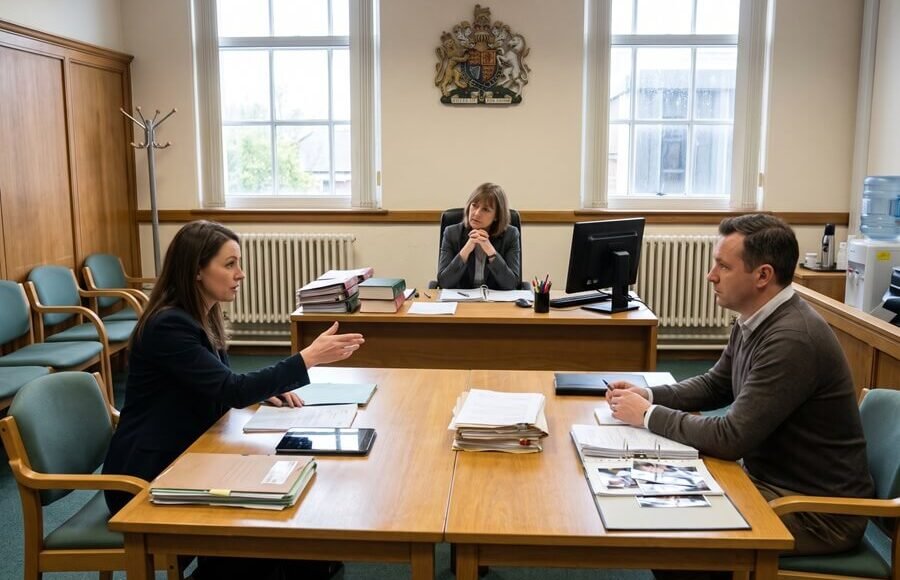
A district judge usually decides the case. The hearing is informal: the strict rules of evidence do not apply, and the judge can use any method that is fair. You don’t need a solicitor, and the winner usually can’t recover legal fees from the loser.
| Type of claim | Small claims limit |
|---|---|
| Most claims, including debts, faulty goods and poor services | £10,000 |
| Personal injury from a road traffic accident | £5,000 for pain and suffering (£1,000 in some cases) |
| Other personal injury | £1,500 for pain and suffering |
| Housing disrepair claims by tenants | £1,000 for the repairs and £1,000 for other damages |
Claims above these limits go to the fast, intermediate or multi-track, where legal costs work differently. If you are a tenant with a disrepair problem, our guide to damp and mould compensation explains your options.
Can I use the small claims court for my claim?
You can use the small claims court to claim money from a person or business in England or Wales. Common claims include:
- an unpaid invoice, loan or bill
- faulty goods or a service that was not done properly
- a deposit that was not returned
- damage to your property or vehicle
- compensation for a cancelled or delayed flight
Is there a time limit?
Yes. Under the Limitation Act 1980, most claims for a debt or breach of contract must start within six years of the breach. Personal injury claims usually have three years.
Will I actually get paid?
A court judgment does not guarantee payment. Before you claim, ask whether the other side has money, a job, property or a trading business. If they have nothing, a judgment may cost you fees without getting your money back.
You also cannot make a claim against someone who is protected by the Breathing Space debt scheme while that protection lasts.
What should I do before making a claim?
Try to settle the dispute first, and send a letter before action. The Practice Direction on Pre-Action Conduct expects both sides to exchange information and consider settling before a claim starts. A court can penalise a party who ignores it.
Send a letter before action
A letter before action sets out what you are owed and why. It also gives a date to pay by before you go to court. Our free Letter before Action builder writes one for you.
If you are a business claiming a debt from an individual, follow the Pre-Action Protocol for Debt Claims. It requires a letter with an information sheet and a reply form, and gives the debtor 30 days to reply.
Work out any interest
You can usually add interest to your claim. For most claims the rate is 8% a year, worked out daily.
Example: you are owed £2,000 and the debt is 100 days overdue. £2,000 × 0.08 = £160 a year. Divided by 365, that is about 44p a day, so the interest is about £43.84.
Business-to-business debts are different. Under the Late Payment of Commercial Debts (Interest) Act 1998, a business can usually claim interest at 8% above the Bank of England base rate.
Gather your evidence
Collect everything that shows what was agreed and what went wrong: the contract or order, invoices, receipts, emails, messages, photos and delivery records. Our small claims court checklist has everything ready.
How do I make a small claim?
You make a small claim online through GOV.UK, or on paper form N1. If you claim online, the fee is worked out for you.
- Check the other side’s full name and address. For a company, use its registered office from Companies House.
- Work out the total you are claiming, including interest.
- Start your claim online. You need the name, address and email address of the person you are claiming against, and a card to pay the fee.
- Pay the claim fee, or apply for Help with Fees first if you have a low income or get certain benefits.
- Explain your claim clearly: what was agreed, what went wrong, how much you are owed and how you worked it out.
- The court sends the claim to the other side and tells you the date they must respond by.
Some claims can’t be made online. These include claims against 3 or more people or organisations, against a government department, or against someone without an address in England or Wales. In those cases, claim by post using form N1 and send it with your fee to the Civil National Business Centre in Northampton.
How much does a small claim cost?
You pay a claim fee when you start, and a hearing fee only if the case is listed for a hearing. Both depend on the amount you claim, including interest, and are set out in the civil court fees list (EX50).
| Amount claimed, including interest | Claim fee | Hearing fee |
|---|---|---|
| Up to £300 | £35 | £27 |
| £300.01 to £500 | £50 | £59 |
| £500.01 to £1,000 | £70 | £85 |
| £1,000.01 to £1,500 | £80 | £123 |
| £1,500.01 to £3,000 | £115 | £181 |
| £3,000.01 to £5,000 | £205 | £346 |
| £5,000.01 to £10,000 | £455 | £346 |
Our small claims court fee calculator works out both fees for your amount. If you win, you can usually claim your fees back from the other side. If you have a low income or get certain benefits, Help with fees can reduce or cover them.
What happens after I make a claim?
The court sends your claim to the other side, who becomes the defendant. They have 14 days to respond after the claim is served, or 28 days if they file an acknowledgment of service. The two sides can agree to extend the time for a defence by up to 28 more days.
The defendant can reply in one of three ways.
- They pay or admit. If they pay in full, the claim ends. If they admit the claim and offer to pay, you can accept the offer or ask the court for judgment.
- They do nothing. Once the deadline passes, you can ask for default judgment online, or on form N225 if you claimed a fixed amount.
- They defend. Both sides complete a directions questionnaire, and most claims up to £10,000 go to free mediation before any hearing.
If they admit only part of the claim and you don’t accept that amount, the claim carries on as a defended claim. A claim can also end at any stage if the defendant pays or the two sides settle.
Do I have to try mediation?
Yes, for most defended claims up to £10,000. GOV.UK says you’ll be told you must attend mediation organised by the court, and the service is free.
- A mediator from HM Courts and Tribunals Service phones you and the other side separately. You don’t have to speak to them directly.
- The appointment lasts up to one hour, and you can have someone with you.
- If you agree terms, the claim is settled on those terms.
- If you don’t agree, the case goes on to a hearing. You can still settle at any point before the hearing date.
Missing the mediation appointment without a good reason is risky. The judge can strike out your claim, or order you to pay costs even if you win. Some claims, including personal injury and housing disrepair claims, are not referred to the mediation service.
What happens at a small claims hearing?
A small claims hearing is informal. Under rule 27.8, the judge can use any method that is fair. The strict rules of evidence do not apply, and evidence does not have to be given on oath. The judge must give reasons for the decision.
If both sides agree, the judge can decide the claim on the papers without a hearing at all, under rule 27.10.
Before the hearing, the court sends directions. These usually tell each side to send copies of their documents to the court and to each other, at least 14 days before the hearing. Follow them exactly, because a judge may refuse evidence that arrives late.
On the day, take:
- the court’s letters and the directions
- your documents in date order, with copies for the judge and the other side
- any witness statements, and your witnesses if they are coming
- a short note of the points you want to make and the amount you are claiming
Defended claims can take months. The median time from issue to trial was 41.0 weeks in April to June 2026, according to Ministry of Justice figures.
What costs can I get back if I win?
On the small claims track, you can recover only limited costs from the other side. Rule 27.14 allows:
- fixed costs for issuing the claim
- the court fees you paid
- reasonable travel and accommodation costs for you and your witnesses to attend the hearing
- a capped amount for earnings lost by attending the hearing
- a capped amount for an expert’s fees, if the court allowed an expert
- a capped amount for legal advice, only in claims that include an injunction
- further costs if the other side behaved unreasonably
The caps are set in Practice Direction 27A. Turning down an offer to settle does not count as unreasonable behaviour by itself.
The same rules work in reverse. If you lose, you could be ordered to pay the other side’s court fees and expenses, but not their solicitor’s bill.
What if I win and they still don’t pay?
If the other side doesn’t pay after judgment, you can ask the court to enforce it. Each method has its own form and fee, set out in the civil court fees list.
| Method | What it does | Court fee |
|---|---|---|
| Order to obtain information | The debtor must attend court and answer questions about their money | £69 |
| Warrant of control | County court bailiffs ask for payment and can take goods to sell | £96 |
| Attachment of earnings order | Payments are taken from the debtor’s wages by their employer | £139 |
| Third party debt order | Money in the debtor’s bank account is frozen and used to pay you | £139 |
| Charging order | The debt is secured against the debtor’s property | £139 |
If you are owed between £600 and £5,000, you can choose the county court or the High Court for enforcement by bailiffs. You cannot enforce while the debtor is in Breathing Space.
An unpaid judgment also goes on the public Register of Judgments. Our guide on what happens if you ignore a CCJ explains the effect on the person who owes the money.
What if someone makes a small claim against me?
Don’t ignore it. You must respond to the claim within 14 days, or within 28 days if you send an acknowledgment of service first. The claim pack explains how to respond online or by post.
You can:
- pay the amount claimed
- admit all or part of the claim and offer to pay, including by instalments
- defend the claim if you don’t owe the money, or think the amount is wrong
- make a counterclaim if the claimant owes you money
If you owe the money but can’t pay it, get free debt advice before the deadline. A debt relief order may be an option if your debts and income are low.
Does this apply in Scotland and Northern Ireland?
No. This guide covers England and Wales only. Scotland and Northern Ireland have their own courts, rules and limits.
| Nation | Procedure | Usual limit |
|---|---|---|
| England and Wales | Small claims track of the county court | £10,000 |
| Scotland | Simple procedure in the sheriff court | £5,000 |
| Northern Ireland | Small claims court, part of the county court | £5,000 |
In Scotland, you make a claim through simple procedure in one of 39 sheriff courts. In Northern Ireland, see the small claims guidance on nidirect. Judgments there are enforced by the Enforcement of Judgments Office, not county court bailiffs.
When should I get legal advice?
You can bring or defend a small claim without a solicitor. Advice is worth getting if:
- your claim is worth more than £10,000, or close to it
- the claim involves a personal injury or a complicated contract
- the other side has a solicitor and you don’t understand their letters
- you have received a claim and may have a counterclaim
- you owe a debt you can’t afford to pay
Free help is available from Citizens Advice, law centres and the Support Through Court charity. Check your home insurance too, because some policies include legal expenses cover.
Quick Answers
No. The small claims track is designed for people who represent themselves. You also usually can’t recover solicitor’s fees from the other side, even if you win.
It depends on whether the claim is defended. If the defendant does nothing, you can ask for judgment soon after the response deadline. In April to June 2026, defended small claims took a median of 41.0 weeks from issue to trial.
No. You can claim the money you lost, interest, court fees and limited expenses. You can also claim a capped amount for earnings lost by going to the hearing, but not a fee for preparing your case.
You may have to pay the other side’s court fees, fixed costs and reasonable expenses. You won’t usually pay their solicitor’s bill unless you behaved unreasonably.
Only in limited cases, and you need permission. The decision must be wrong, or unjust because of a serious problem with how the case was handled. Under CPR Part 52, you usually have 21 days to file an appeal notice.