
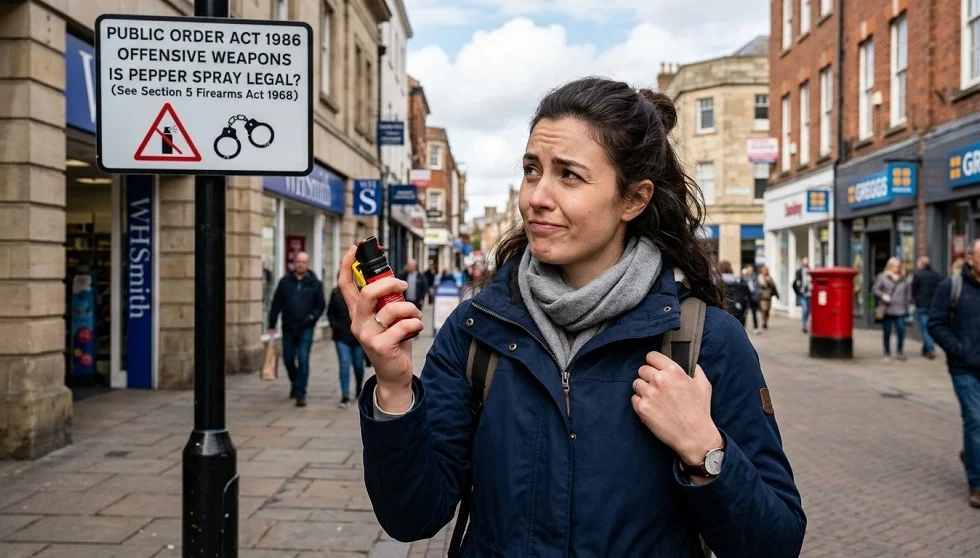
Pepper spray is illegal for civilians to possess, buy, carry or use anywhere in the UK. It’s classified as a prohibited weapon under Section 5(1)(b) of the Firearms Act 1968, the same law that covers handguns, and there’s no self-defence exception. Anyone caught with it can be prosecuted in the Magistrates’ Court or the Crown Court, with a maximum sentence of 10 years’ imprisonment. Legal alternatives include criminal identifier sprays and personal attack alarms.
Pepper spray, sometimes sold as OC spray, CS spray or mace, is not something you can lawfully carry in the UK under any circumstances. The law treats it as a prohibited firearm rather than a self-defence product, and that classification carries real consequences if you’re stopped with one.
Carrying pepper spray “just in case” is treated by the law the same way as carrying an unlicensed handgun, not as a self-defence choice.
Below is what the Firearms Act 1968 actually says, how the penalties work in practice, what happens if you’re caught with an improvised spray rather than a manufactured one, and what you can legally carry instead.
What Counts as Pepper Spray Under UK Law?
Section 5(1)(b) of the Firearms Act 1968 prohibits “any weapon of whatever description designed or adapted for the discharge of any noxious liquid, gas or other thing.” That wording is broad by design. It catches OC spray (oleoresin capsicum, the active ingredient in most pepper sprays), CS spray, PAVA spray (the type UK police use) and any product marketed as mace, regardless of the brand or packaging.
The test is about function, not the label on the canister. If a product is designed to discharge a substance capable of causing pain, irritation or incapacitation, it falls within the definition, whether the manufacturer calls it a “self-defence spray,” a “personal protection spray” or anything else.
This is also why criminal identifier sprays, dye-based products containing no noxious substance, sit outside the ban. That distinction is covered later in this article.
Why There’s No Self-Defence Exception?
Possessing a Section 5 prohibited weapon is an offence in itself. It makes no difference whether you’ve only ever intended to use it defensively, never taken it out of a bag, or bought it specifically because you felt unsafe. The offence is complete the moment you possess, purchase or carry the item without lawful authority.
This applies across England, Wales and Scotland under the same Firearms Act 1968. Northern Ireland runs its own but materially equivalent framework under the Firearms (Northern Ireland) Order 2004, which prohibits pepper spray on the same basis.
The only people who can lawfully carry it are those with specific authority, chiefly police officers trained and equipped with PAVA spray as part of their operational role, and certain accredited personnel operating under Home Office authorisation. That authority isn’t something a private individual can apply for.
The Real Penalties (And a Correction Worth Making)
Possession of a Section 5(1)(b) prohibited weapon is triable either way, meaning it can be heard in the Magistrates’ Court or the Crown Court depending on the seriousness of the case. In the Magistrates’ Court, the maximum sentence is 6 months’ imprisonment, a fine, or both. Sent to the Crown Court, the maximum rises to 10 years’ imprisonment, an unlimited fine, or both.
A number of articles on this topic state that pepper spray possession carries a mandatory minimum sentence of 5 years. That’s incorrect, and worth correcting directly. The mandatory minimum term provisions, set out in section 311 of the Sentencing Act 2020, apply only to specific Firearms Act subsections, principally section 5(1)(a) and section 5(1A)(a), which cover things like disguised firearms and certain automatic weapons. Section 5(1)(b), the provision that actually covers pepper spray, isn’t one of them. The Crown Prosecution Service’s own guidance and a 2024 Justice Committee report on Sentencing Council consultations both confirm this directly.
That doesn’t make the offence minor. Sentencing under the Sentencing Council’s guideline for possessing a prohibited weapon, in force since January 2021, is based on culpability and harm rather than a fixed tariff, and a Crown Court sentence for this offence can still run into years depending on the circumstances. The court decides based on the specific facts of each case, and the statute alone can’t tell you in advance where a sentence will land.
In practice, a first-time possession case involving a small personal canister, no prior record, no intent to cause harm, and an early guilty plea tends to be dealt with far more leniently than the maximum figures suggest.
If you’re arrested under section 5(1)(b), the process runs through arrest and caution, a police interview (usually with a duty solicitor present), a charging decision by the CPS applying the Full Code Test, a first hearing to enter a plea, and sentencing if convicted.
What If It Wasn’t a Manufactured Spray?
A recurring question is what happens if the item wasn’t a purpose-built spray canister at all, for example a bottle filled with a noxious liquid.
In R v Upton and Formosa [1990], the Court of Appeal considered a washing-up liquid bottle filled with acid. The court held that the words “designed or adapted” in section 5 require some physical alteration to the object itself. An ordinary household bottle, unmodified beyond being filled with a different liquid, hadn’t been “adapted” in the sense the Act requires, so the conviction under section 5(1)(b) was quashed.
That doesn’t make improvising a spray a loophole. An item carried with intent to cause injury can still amount to an offensive weapon under the Prevention of Crime Act 1953, which covers anything made, adapted, or intended by the person carrying it to cause injury, carried in public without lawful authority or reasonable excuse. The Upton and Formosa case narrows which specific offence applies. It doesn’t create a lawful way to carry something for the purpose of spraying an attacker.
Bringing Pepper Spray Into the UK
Pepper spray being legal to buy where you live doesn’t change its status once you’re travelling with it into the UK. Firearms Act prohibited weapons are prohibited goods for customs purposes, and Border Force can and does seize them at UK airports and ports.
Genuine unfamiliarity with UK law isn’t a defence. Visitors arriving from countries where pepper spray is sold openly, commonly the United States, are the group most likely to be caught out by this, usually because the item was packed without a second thought. If pepper spray is found in checked or hand luggage on arrival, it will typically be seized, and depending on the circumstances the traveller can face the same possession offence as anyone else.
Buying Pepper Spray Online
Genuine OC or CS spray is a prohibited weapon to sell as well as to possess, so listings for real pepper spray are routinely removed from UK-facing marketplaces. Most products advertised as “UK legal pepper spray” on sites like Amazon are actually criminal identifier sprays, the dye-based alternative covered below, marketed under pepper spray branding because that’s the search term people use.
Ordering genuine pepper spray from an overseas seller and having it shipped to a UK address doesn’t get around the law either. It’s still an unlawful import, and the parcel can be intercepted, with the recipient potentially facing the same offence as if they’d carried it in themselves.
Reasonable Force and Self-Defence
UK law does allow people to defend themselves. Section 3 of the Criminal Law Act 1967, the common law doctrine of self-defence, and section 76 of the Criminal Justice and Immigration Act 2008 together set the test: you can use force that is reasonable in the circumstances as you genuinely believed them to be at the time.
That test applies to force used in the moment, not to preparing in advance. Grabbing a bag, an umbrella or keys during an actual attack and using them defensively is judged under this reasonableness test after the fact. Carrying an item specifically because you intend it as a weapon if needed is a different situation, since the offence of possessing or carrying a weapon, whether under the Firearms Act or the Prevention of Crime Act, can be complete before any force is ever used, regardless of how reasonable that force might later have been.
Legal Alternatives to Pepper Spray
The same statutory test that bans pepper spray, whether a product discharges a noxious substance, is what makes these alternatives lawful:
- Criminal identifier sprays such as Farbgel, covered in detail above, mark an attacker rather than incapacitating them, and are legal because they contain no noxious substance.
- Personal attack alarms emit a loud sound, typically well over 100 decibels, intended to startle an attacker and draw attention. They contain no substance at all, so they fall outside section 5 entirely.
- Tactical torches aren’t classified as weapons and can be carried freely; a sudden bright light can disorient an attacker for long enough to create distance.
- Personal safety apps that share your location and alert contacts or the police don’t raise any weapons law issue, since nothing physical is being carried.
What Is Farbgel, and Why Is It Legal?
Farbgel, also spelled Farb-Gel, is the best-known example of a criminal identifier spray sold in the UK as a pepper spray alternative. It’s manufactured in Germany and fires a stream of red gel rather than an irritant.
The mechanism is different from pepper spray by design. Instead of causing pain or incapacitation, Farbgel works by startling an attacker and briefly obscuring their vision with the gel itself, typically from a range of up to four metres, then leaving a bright red dye on their skin and clothing that’s difficult to wash off for several days, giving police something to identify the attacker by afterwards.
That’s also the reason it falls outside the Firearms Act ban. Section 5(1)(b) only catches devices designed or adapted to discharge a “noxious” liquid or gas, meaning something capable of causing harm through toxicity or irritation. The manufacturer states the gel is a non-toxic, food-grade dye rather than an irritant compound, so the product isn’t designed to discharge a noxious substance and doesn’t meet the statutory definition that makes pepper spray illegal.
It isn’t the only product built this way. VestGuard’s EveAid spray works on a similar principle, combining a non-noxious deterrent scent with a UV dye rather than a visible one.
That legality is worth qualifying rather than treated as a free pass. Using it still has to meet the reasonable force test covered below: spraying someone who isn’t actually threatening you can amount to an assault, even though the product itself is legal to own. Its legal status also rests entirely on formulation, not packaging, so buying from an established UK-facing supplier matters more than it would for an ordinary consumer product. And because it works through disorientation and marking rather than incapacitation, it doesn’t offer the same stopping power an irritant spray is designed to provide.
What to Do If You Already Have Some
If you already own pepper spray, whether bought before realising it was illegal here or brought back from travel, the safest route is to hand it in to your local police force rather than keep it, dispose of it in household rubbish, or attempt to post it anywhere. Most forces accept voluntary surrender of prohibited items, and contacting them directly, or via the 101 non-emergency line, to arrange this avoids the risk of being found in possession of it later.
Frequently Asked Questions
No. CS spray is covered by the same section 5(1)(b) provision as pepper spray and OC spray, and is treated identically under the law.
No. “Mace” is a brand name that’s become a generic term for OC-based self-defence sprays, and it’s banned on exactly the same basis as any other pepper spray.
Only officers trained and authorised to carry PAVA spray as part of their operational equipment can use it, and only in line with their force’s use-of-force policy. It isn’t available to police support staff or the public.
Yes. The offence is possessing or carrying the item, so intent to use it plays no part in whether you’re guilty, though it can influence sentencing if you’re convicted.