
Phones, doorbell cameras and, increasingly, smart glasses have made filming strangers routine, and the rules that apply are spread across harassment, privacy, data protection and sexual offences law. This article sets out the position in England and Wales as of 8 October 2026. Scotland and Northern Ireland have their own laws on harassment, voyeurism and privacy, so the details differ there.
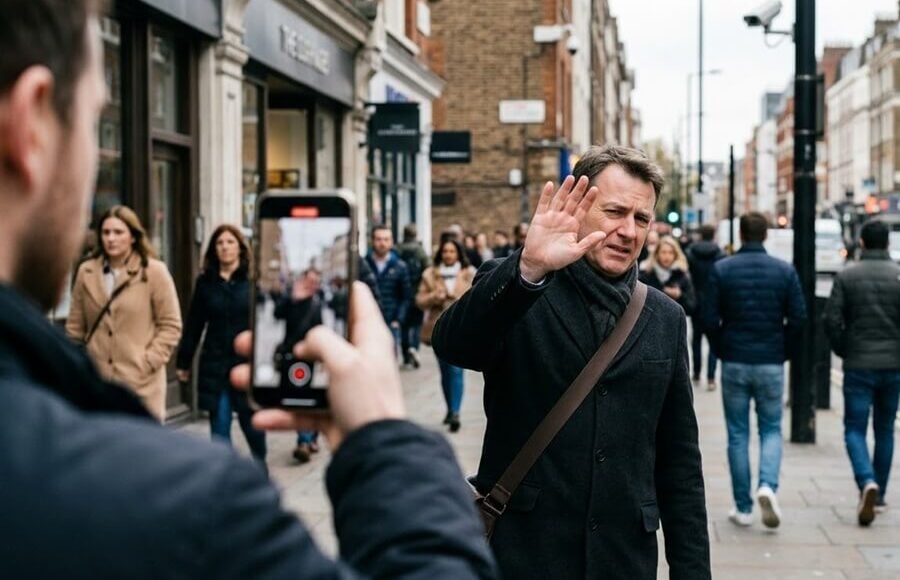
It is lawful to film people in a public place in England and Wales without their consent, but harassment, sexual offences, privacy and data protection law can still make the filming, or what you do with the footage, unlawful.
What the Law Says About Filming in Public?
No offence of filming in a public place exists in England and Wales. The Metropolitan Police’s photography advice states that members of the public and the media do not need a permit to film or photograph in public places, and that officers have no power to stop them filming incidents or police personnel.
Public does not mean unregulated. A person in a street or park has a lower expectation of privacy than a person at home, but not none, and four areas of law can still apply. Harassment law looks at the pattern of filming. Sexual offences law looks at the purpose and the setting. Privacy law asks what the footage reveals and where it is published. Data protection law asks whether you are handling personal data beyond a purely personal or household activity.
Privately owned places work differently. Shopping centres, stations, schools, leisure centres and venues set their own rules, and the occupier can ask you to stop filming or to leave. Filming there is not a criminal offence in itself, but refusing to comply can make you a trespasser.
When Filming Becomes a Problem?
The Protection from Harassment Act 1997 prohibits a course of conduct, meaning conduct on at least two occasions, that amounts to harassment of another person and that the person knows or ought to know amounts to harassment. Section 2 makes it a criminal offence and section 3 gives the person a civil claim for damages or an injunction. Filming a stranger once is unlikely to meet that test. Following someone and filming them repeatedly, confronting them for content, or posting footage and encouraging others to contact or target them can.
Two sexual offences matter for filming. Section 67 of the Sexual Offences Act 2003 covers voyeurism, which includes recording another person doing a private act, such as using a toilet or being undressed in a place where they would reasonably expect privacy, intending that the image will be looked at for sexual gratification. Section 67A covers upskirting, which is recording beneath someone’s clothing to see their genitals, buttocks or underwear, either for sexual gratification or to humiliate, alarm or distress them. Each carries a maximum of two years’ imprisonment.
Privacy Law and Posting Footage Online
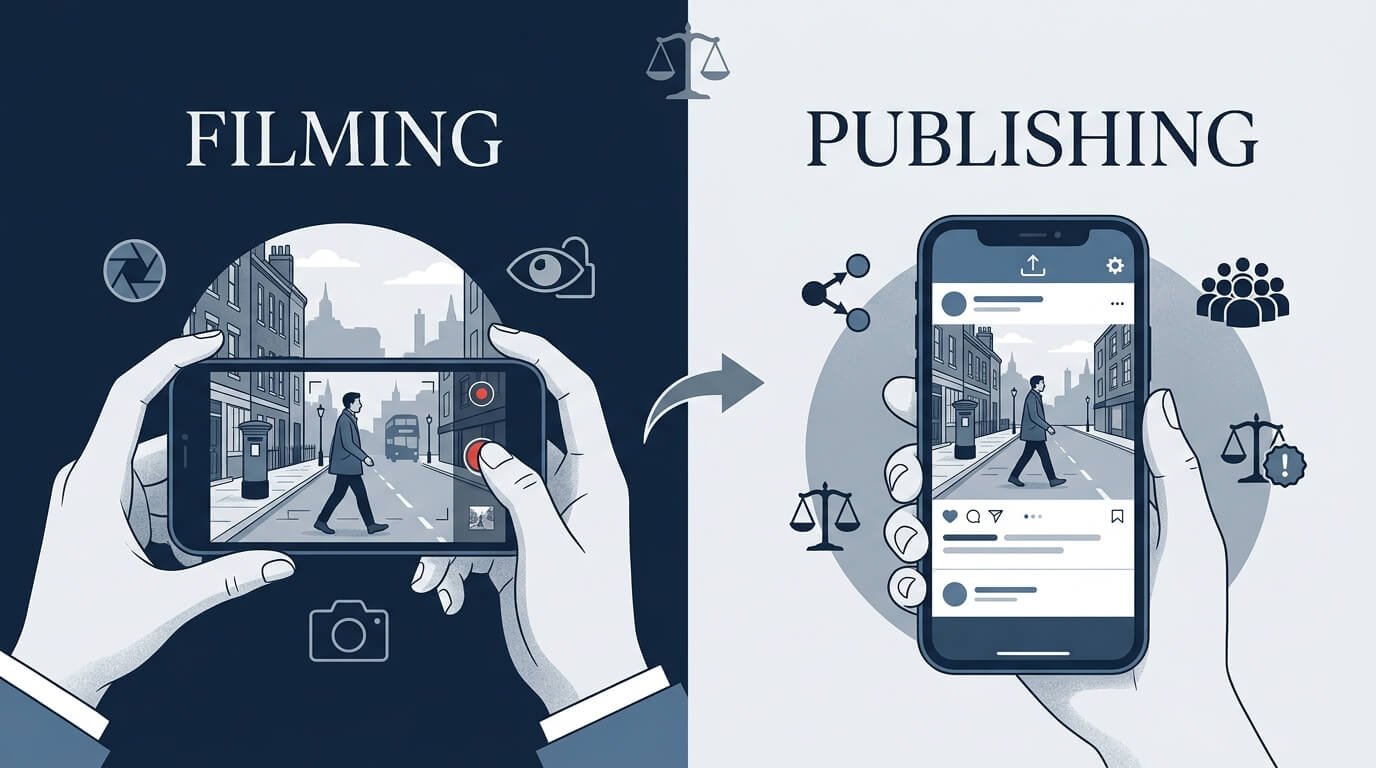
Filming someone and publishing the footage are separate acts in law. The tort of misuse of private information protects information about which a person has a reasonable expectation of privacy, and it can apply to something that happened in public. In Campbell v MGN [2004] UKHL 22, the House of Lords held that publishing photographs of Naomi Campbell leaving a Narcotics Anonymous meeting breached her privacy, because the pictures revealed private health information.
In Murray v Express Newspapers [2008] EWCA Civ 446, the Court of Appeal allowed a claim to proceed on behalf of a young child photographed in an Edinburgh street. The court said the answer depends on all the circumstances, including the place, the activity, the purpose of the filming, whether the person consented and the effect on them. A clip singling out one person at a vulnerable moment raises more concern than a general shot of a crowded street.
Data protection law adds another layer. The UK GDPR and the Data Protection Act 2018 apply when you record and publish footage of identifiable people, and the exemption for purely personal or household activity in Article 2(2)(c) is narrow. In a February 2026 analysis for Inforrm, Professor Subhajit Basu argues that monetised channels built on filming strangers are unlikely to fall within it. Enforcement against ordinary one-off filming is rare, but a creator who publishes identifiable footage of strangers for views or income carries more risk.
Can the Police Stop You Filming?
No. The Metropolitan Police advice says officers have no power to stop people filming or photographing incidents or police personnel, and that they have no power to delete digital images or destroy film during a search. Deletion after seizure is lawful only under a power such as a court order.
The stop-and-search power in section 44 of the Terrorism Act 2000 no longer exists. Section 43 still allows an officer to stop and search a person reasonably suspected of being a terrorist, to view images on a phone or camera, and to seize items that may be evidence of terrorism. Whether an officer can take a device as evidence depends on the specific power relied on, in the same way that the rules on police seizing knives from your home without a warrant turn on the exact statute the officer cites. None of this prevents an arrest for a separate offence, such as obstructing an officer or harassment, if the facts support it.
Filming Police Officers
Filming police officers is lawful in general. The one provision that comes up is section 58A of the Terrorism Act 2000, inserted by section 76 of the Counter-Terrorism Act 2008. It makes it an offence to elicit, publish or communicate information about a constable, a member of the armed forces or the intelligence services that is of a kind likely to be useful to a person committing or preparing an act of terrorism. The maximum penalty on indictment is ten years’ imprisonment, and it is a defence to show a reasonable excuse.
The Metropolitan Police advice says it would ordinarily be unlawful to use section 58A to arrest people photographing officers during normal policing, including at protests. An arrest needs reasonable suspicion that the images were meant to provide practical assistance to a terrorist act.
Doorbell Cameras, CCTV and Neighbours
Home cameras are where the household exemption most often fails. In Fairhurst v Woodard, decided in Oxford County Court on 12 October 2021, HHJ Melissa Clarke upheld harassment and data protection claims against a neighbour who ran a video doorbell and several cameras. The court found the doorbell’s video lawful as incidental capture of a public street, but held that its audio, which could pick up conversations from more than 60 feet away, was disproportionate, and that the driveway camera’s recording was unlawful. A private nuisance claim failed.
A county court decision does not bind other courts, but it shows that audio is harder to justify than video.
Filming Children, and Filming for Content or Business
Nothing in the law of England and Wales makes it an offence to film a child in a public place, and there is no general rule requiring a parent’s consent. A child can still have a reasonable expectation of privacy, as Murray shows, and schools, leisure centres and sports grounds can set their own filming rules as occupiers.
Filming for a personal keepsake sits within the household exemption. Filming for a monetised channel, a business or a campaign does not, because the footage is no longer purely personal, and data protection duties such as having a lawful basis and dealing with objections can apply. Larger commercial shoots on land owned by someone else usually need the owner’s permission or a location agreement.
What is Changing and What is Still Unclear?
Two developments are worth tracking, both as of 8 October 2026. First, Schedule 13 to the Crime and Policing Act 2026 inserts new offences into the Sexual Offences Act 2003, including taking or recording an intimate image without consent (section 66AB). The Schedule includes an exemption for images taken voluntarily in public places where the person has no reasonable expectation of privacy. The legislation.gov.uk text of Schedule 13 shows these offences as prospective, and I found no commencement regulations bringing them into force.
Second, wearable cameras such as smart glasses make covert recording easier, and reports in 2026 describe manufacturer recording lights being bypassed. No separate law applies to them. The same rules on harassment, voyeurism, privacy and data protection govern a recording made with glasses as one made with a phone. Professor Basu’s Inforrm analysis argues for regulating wearable devices and platform monetisation, but no new offence for filming in public has been enacted.
Common Myths About Filming in the UK
“You need someone’s consent to film them.” There is no general consent requirement for filming in a public place. Consent becomes relevant to publishing, to privacy claims and to filming on private premises.
“Police can make you delete your footage.” They cannot. They have no power to delete images, and deletion after seizure requires a lawful power such as a court order.
“It is illegal to film children.” It is not, but posting identifiable footage of a child can raise privacy and data protection issues, and venues set their own filming rules.
“Anything filmed in public can be published.” Campbell shows that publication can breach privacy even where the filming itself was lawful.
“Covert filming is always illegal.” There is no general offence of filming covertly. Recording a private act in a bathroom or changing area can be a sexual offence, and hidden cameras that capture guests or neighbours can breach data protection and privacy law.
What to Do if Someone Films You?
You have no legal right to stop someone filming you in public, but there are steps to take if the filming is intrusive or the footage is posted:
- Ask the person to stop or to delete the footage. They are under no legal duty to do so, but it can resolve the matter.
- Keep evidence, including the date, location, any messages and screenshots or copies of the footage.
- Report the post to the platform, which can remove content that breaches its rules or that is harassing.
- If the filming is repeated or intimidating, report it to the police as harassment (101, or 999 if you are in danger).
- Ask the poster to remove identifiable footage under data protection law and, if they refuse, complain to the Information Commissioner’s Office.
- For serious cases, seek advice from a solicitor about a civil claim for harassment or misuse of private information.
Workers in public-facing roles meet this regularly when customers film staff during disputes. From 30 October 2026, employers in Great Britain will have to take all reasonable steps to prevent harassment of staff by third parties, so the employer duty to prevent harassment of staff by customers may be relevant where repeated filming and abuse of a worker goes unaddressed.
Quick Answers
Filming strangers in a public place is lawful, but posting identifiable footage can breach privacy or data protection law, particularly if the person is shown at a vulnerable moment or the channel earns money. Removing the footage when someone objects reduces the risk.
No. Police have no power to delete images or destroy film. Footage can be seized as evidence only where an officer has a specific lawful power, such as under section 43 of the Terrorism Act 2000, and any later deletion needs a court order or similar authority.
Yes. Officers have no power to stop people filming them in a public place. Section 58A of the Terrorism Act 2000 makes it an offence to elicit or publish information about officers that is likely to be useful to terrorists, but photographing officers during normal policing is not an offence in itself.
There is no general offence of filming a child in a public place and no general parental consent rule in England and Wales. Posting identifiable footage of a child can still raise privacy and data protection issues, and schools, leisure centres and sports venues can set their own filming rules.