

Poppers, chemically known as alkyl nitrites, are legal to possess and use in the UK. They were never classed as controlled drugs under the Misuse of Drugs Act 1971, and in 2016 the government accepted advice that they fall outside the Psychoactive Substances Act 2016 because their effect on the body is indirect rather than a direct action on the brain. A 2018 Court of Appeal ruling has since cast doubt on that reasoning, and a 2024 official recommendation to formally exempt poppers by law still hasn’t been acted on. In practice, possession and use are not prosecuted, but selling or marketing them explicitly for inhalation carries more legal risk than most guides admit.
Poppers are widely sold in the UK, in shops, at festivals and online, usually labelled as room aromas, leather cleaners or nail varnish removers rather than as a drug. That labelling isn’t just marketing. It reflects a genuine, unresolved gap in how the law treats them.
Poppers sit in a category the law was never quite designed to cover, and the position has never been fully closed off, only left alone in practice.
Below is what actually governs their legal status, why a 2018 court decision reopened a question the government thought it had settled in 2016, and where things stand as of 2026.
What Poppers Are, Legally Speaking
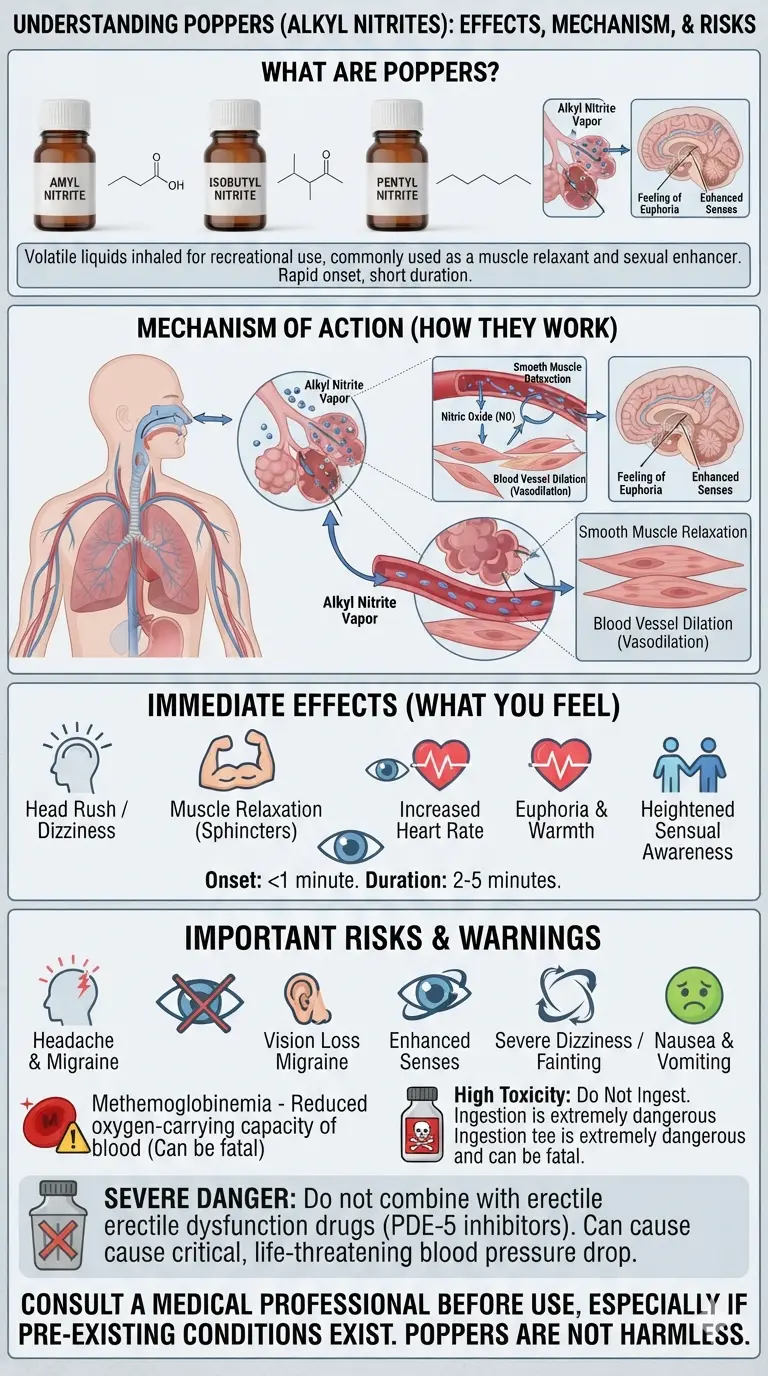
Poppers is the common name for alkyl nitrites, a group of volatile liquids including amyl, butyl, isobutyl and isopropyl nitrite. Inhaling the vapour causes blood vessels to dilate, producing a brief head rush and relaxing smooth muscle, including around the anal sphincter, which is why the product is widely used as a sexual aid, particularly among men who have sex with men.
They are not listed as a controlled drug under the Misuse of Drugs Act 1971, so possession has never been an offence under that Act. The more relevant, and more complicated, legislation is the Psychoactive Substances Act 2016.
Why the Psychoactive Substances Act 2016 Doesn’t Currently Catch Them
The Psychoactive Substances Act 2016 banned the production, supply and importation of any substance capable of producing a psychoactive effect for human consumption. Section 2(2) defines that effect as one produced by stimulating or depressing the central nervous system.
During the Act’s passage through Parliament in early 2016, MPs raised concern that poppers would be swept up in the ban. The government asked the Advisory Council on the Misuse of Drugs to assess the point, and in March 2016 the Council concluded that alkyl nitrites work through a peripheral effect, dilating blood vessels rather than acting directly on the brain, and therefore don’t meet the Act’s own definition of a psychoactive substance. The then Home Office minister, Karen Bradley, accepted that advice and confirmed that the police would not pursue prosecutions for the sale, purchase or use of poppers on that basis.
That’s the origin of “poppers are legal in the UK.” It’s accurate as a description of enforcement practice. It was never a formal, written exemption in the Act itself.
The 2018 Ruling That Complicated Things
In R v Rochester [2018] EWCA Crim 1936, a case actually concerning nitrous oxide, the Court of Appeal considered whether the Psychoactive Substances Act requires a substance to act directly on the central nervous system to count as psychoactive. The court held that it doesn’t. An indirect effect is enough.
That’s a problem for the reasoning the 2016 popper exemption was built on, since the entire basis for excluding poppers was that their effect on the brain is indirect. Rochester didn’t concern poppers directly, and no prosecution has since tested the point against them specifically, but it removed the legal foundation the 2016 position rested on without anyone formally revisiting that position.
Where the Law Actually Stands Now
The government commissioned the Advisory Council on the Misuse of Drugs to look at the issue again, and in 2024 the Council published an updated harms assessment recommending that alkyl nitrites be formally exempted from the Psychoactive Substances Act 2016 by adding them to Schedule 1, the Act’s list of excluded substances. That would close the gap Rochester opened by writing the exemption into the statute itself, rather than leaving it as a matter of enforcement policy.
As of the Advisory Council’s most recent work programme, published in 2026, that recommendation still hasn’t received a full government response. The practical legal position for anyone using or selling poppers today is therefore the same as it’s been since 2016 (no prosecutions in practice), but it’s resting on non-enforcement rather than on a settled piece of legislation, and that gap has now been open since the 2018 ruling.
Possession Versus Selling: Where the Real Risk Sits
For personal possession, the practical position is straightforward. Individuals are not prosecuted for having or using poppers, and this has been consistent government and police practice since 2016.
Selling or supplying them is where the legal exposure is greater. The Psychoactive Substances Act’s supply offence targets substances marketed for human consumption, so a retailer who sells or advertises poppers explicitly as something to inhale, rather than as a genuine household product, is taking on legal risk that a company selling the same liquid as a leather cleaner or nail varnish remover isn’t. That’s the real reason almost every UK popper retailer uses that kind of packaging and labelling. It isn’t a loophole so much as a direct response to where the Act’s supply offence actually bites.
Buying Poppers in the UK
Poppers are widely available from specialist shops and online retailers, typically sold in small bottles under brand names that make no reference to inhalation or sexual use. Buying from an established UK-facing retailer matters here in a practical sense, since product purity and labelling accuracy vary considerably between suppliers, and there’s no regulatory body checking the contents of a bottle sold as a room aroma the way there would be for a licensed medicine.
A Health Risk Worth Knowing, Separate From the Legal Question
Being legal isn’t the same as being risk-free, and one specific interaction is worth flagging here since it’s a genuine safety issue rather than a legal one. Combining poppers with PDE5 inhibitor medications, sildenafil (Viagra), tadalafil (Cialis) and vardenafil among them, is medically recognised as dangerous. Both work by dilating blood vessels through the same pathway, and taken together they can cause a severe, rapid drop in blood pressure.
This isn’t a niche concern. It’s the kind of interaction pharmacists and prescribing information warn about specifically, and it’s worth treating seriously rather than as a footnote. Anyone taking, or considering taking, erectile dysfunction medication should get advice from a pharmacist or GP before combining it with poppers, rather than relying on general assumptions about two legal products being safe to use together.
Frequently Asked Questions
Are poppers a controlled drug in the UK?
No. Alkyl nitrites have never been listed under the Misuse of Drugs Act 1971, so possession isn’t an offence under that Act.
Could poppers ever be banned outright?
It’s possible in theory, since the Rochester ruling means the legal basis for the current exemption is weaker than it was in 2016, but there’s no indication of an active move to prosecute possession, and the official recommendation on the table points toward formally protecting the exemption rather than removing it.
Why are poppers sold as room aromas instead of as a sexual aid?
Because marketing a product explicitly for inhalation increases legal exposure under the Psychoactive Substances Act’s supply offence. Labelling it as a household product is a deliberate way of staying outside that risk.
Is it illegal to bring poppers into the UK from abroad?
Since they’re not a controlled substance and enforcement practice treats them as legal to possess, bringing a personal quantity into the UK isn’t treated as importing a prohibited drug in the way a controlled substance would be.
Does the law differ across England, Wales, Scotland and Northern Ireland?
No. The Misuse of Drugs Act 1971 and the Psychoactive Substances Act 2016 both apply UK-wide, so the position is the same in all four nations.