
Tasers and stun guns get lumped together in most guides on this topic, and the underlying law does treat them the same way in most respects. Where they diverge, in the specific case of a device disguised as something else, is a distinction worth getting right, since it changes the sentencing exposure considerably.
What the Law Says
Tasers and stun guns are illegal for civilians to possess, buy, carry or import anywhere in the UK. Both are classed as prohibited weapons under Section 5(1)(b) of the Firearms Act 1968, whether the device delivers a shock at a distance (a taser) or only on direct contact (a stun gun). There’s no self-defence exception. The maximum sentence is 10 years’ imprisonment. A tougher mandatory minimum 5-year term exists for disguised devices, such as a stun gun built into a torch, but current CPS charging guidance means most disguised devices are still charged in a way that avoids it, unless something beyond the disguise itself makes the case more serious. Only trained, authorised police officers can lawfully carry one.
A taser and a torch that happens to also be a stun gun are not the same offence under UK law, even though both are illegal to carry.
Below is what actually makes them illegal, how UK police use them under a specific authorised exception, and how the penalty structure genuinely differs depending on whether the device is disguised.
What Counts as a Taser or Stun Gun Under UK Law
Section 5(1)(b) of the Firearms Act 1968 prohibits any weapon designed or adapted to discharge a noxious liquid, gas or other thing. Courts have interpreted “other thing” broadly enough to include an electrical discharge, which is why both taser-type devices, which fire barbed probes on wires to deliver a shock from a distance, and stun guns, which require the device to touch the target directly, fall within the same statutory definition.
The law makes no meaningful distinction between the two for the purpose of the offence. Whether a product is marketed as a taser, a stun gun, a “self-defence torch” or anything else, what matters is whether it’s designed to deliver an electric shock capable of incapacitating someone.
How a Taser Actually Works?
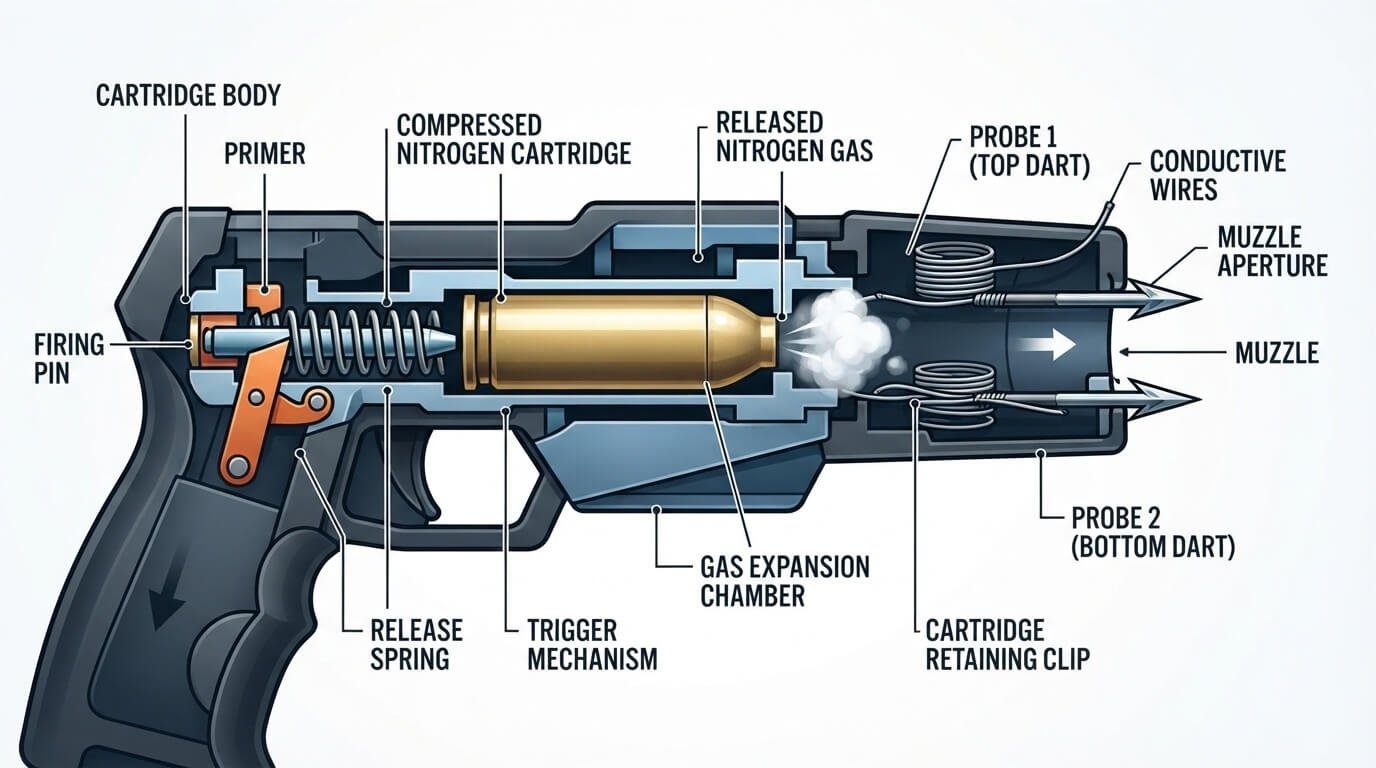
The mechanism is simpler than most people assume. Pulling the trigger releases a small nitrogen-pressurised cartridge, firing two barbed metal probes forward, each trailing a thin insulated wire back to the handset. Once both probes make contact with a target, or with clothing close enough to the skin, the circuit is completed and the device’s internal battery and step-up circuitry send pulses of electrical current down the wires. A stun gun works on the same underlying principle, minus the cartridge and probes, the device itself has to touch the target directly rather than firing anything at range, which is the practical distinction the law draws between the two in most other respects while still prohibiting both equally.
Why There’s No Civilian Exception
Possessing, purchasing, acquiring, manufacturing or selling a taser or stun gun without lawful authority is an offence regardless of intent. As with other Section 5 prohibited weapons, there’s no self-defence exception and no permit or licensing route that allows a private individual to own one. Authority to possess these devices is granted only by the Secretary of State, and that authority is not extended to members of the public.
This applies across England, Wales and Scotland. Northern Ireland operates parallel legislation that prohibits tasers and stun guns on materially the same basis.
The Penalty That Actually Depends on Disguise
An ordinary taser or stun gun, sold and carried as what it obviously is, is charged under section 5(1)(b). That offence is triable either way, with a maximum sentence of 10 years’ imprisonment in the Crown Court, and it does not carry a mandatory minimum term.
A device disguised as something else, most commonly a stun gun built into a torch, can in principle be charged differently. Section 5(1A)(a) covers disguised firearms specifically, and a conviction under that provision does trigger the mandatory minimum term set out in section 311 and Schedule 20 of the Sentencing Act 2020, currently 5 years for an adult offender, unless the court finds exceptional circumstances that justify departing from it.
In practice, it’s more complicated than “disguised equals mandatory minimum.” The Sentencing Council noted that courts were finding exceptional circumstances to avoid the mandatory minimum in around two-thirds of disguised weapon cases, which undermined the point of having a mandatory term at all. As a result, current CPS charging guidance directs prosecutors to charge a disguised stun gun under the ordinary section 5(1)(b) provision, the one that doesn’t carry a mandatory minimum, unless there’s a specific aggravating feature beyond the fact of disguise that justifies the more serious charge. A stun gun built into a torch doesn’t automatically mean the harsher charge, or the mandatory sentence, despite what a lot of guides on this topic imply.
A number of guides on this topic still state flatly that any taser carries a mandatory 5-year sentence. That’s not accurate even for most disguised devices under current charging practice, let alone an ordinary taser, which is sentenced under the same discretionary framework as pepper spray and other non-disguised Section 5(1)(b) items, based on culpability and harm rather than a fixed minimum term.
How UK Police Use Tasers
Tasers were first introduced into UK policing in 2003 for use by authorised firearms officers only. Following a trial period, authorisation was extended in 2007 and 2008 to allow trained officers outside specialist firearms units to carry them. Officers issued with a taser complete dedicated less-lethal weapons training before certification, followed by annual refresher training, and use is governed by their force’s use-of-force policy, requiring that deployment be lawful, proportionate and necessary.
This authorisation is specific to trained, vetted officers acting in their operational role. It has no bearing on what a private individual can lawfully carry.
Buying or Importing a Taser
A taser or stun gun is a prohibited weapon to sell as well as to possess, so genuine devices aren’t legally listed on UK marketplaces. Ordering one from an overseas seller and having it shipped to a UK address doesn’t avoid the offence either. Customs treat these as prohibited goods, parcels can be intercepted, and the recipient can face the same possession charge as someone caught carrying one in public, regardless of where it was bought or how it arrived.
How This Compares to Pepper Spray
Tasers, stun guns and pepper spray are all Section 5 prohibited weapons under the same Firearms Act 1968, and the core legal position is identical: no self-defence exception, no civilian permit route, and the same police-only authorisation model. Our guide to whether pepper spray is legal in the UK covers the equivalent penalty structure, including the same correction that applies here, that the standard Section 5(1)(b) offence doesn’t carry a mandatory minimum term, only specific disguised or high-risk categories do.
Legal Alternatives for Personal Safety
The alternatives that are lawful for pepper spray apply equally here, since none of them involve an electrical discharge or a noxious substance:
- Personal attack alarms, which emit a loud sound to startle an attacker and attract attention, contain no substance or mechanism that brings them within section 5.
- Criminal identifier sprays, such as Farbgel, mark an attacker with a non-toxic dye rather than incapacitating them, and are legal for the same reason pepper spray isn’t.
- Tactical torches aren’t classified as weapons in their own right and can be carried freely, provided the device is genuinely just a torch rather than a disguised stun gun.
- Self-defence training focused on de-escalation and physical technique doesn’t raise any weapons law issue at all.
Quick Answers
Yes. Possession itself is the offence, regardless of whether the device is ever carried or used.
No. Authorisation is limited to specifically trained police officers. Private security roles don’t carry any exemption under the Firearms Act.
None, for the purposes of the offence. Both fall under the same Section 5(1)(b) prohibition regardless of whether the shock is delivered at range or on contact.