
Yes, but only some pocket knives, and only if they pass a strict two-part test. It is an offence to have any bladed or sharply pointed article in a public place without a good reason. The one exception is a folding pocket knife with a cutting edge of 3 inches or less, and a knife that locks open does not qualify however short it is.
The 3 Inch Rule | It’s an Exception, Not a Legal Length
Many knife retailers describe 3 inches as the “legal length” for carrying a knife. That is not quite right, and the difference matters if you are stopped.
The law does not set a safe blade length. It makes it an offence to have any article with a blade or point in a public place, then carves out one narrow exception for folding pocket knives. A knife that is not a folding pocket knife can be an offence even if the blade is 2 inches long. For the same reason, a fixed-blade whittling knife with a short blade does not qualify, because a fixed blade is not a folding knife.
The Law in England and Wales
Section 139 of the Criminal Justice Act 1988 makes it an offence to have an article with a blade or sharp point with you in a public place. Subsection (3) takes folding pocket knives out of the offence, but only if the cutting edge of the blade does not exceed 3 inches.
It is a defence to prove you had good reason or lawful authority for the knife. Section 139(5) also names three specific defences: carrying the knife for use at work, for religious reasons, or as part of a national costume.
The burden is on you. As one police force puts it, it is for the person to prove, on the balance of probabilities, that they had a good reason. The prosecution does not have to disprove it.
The maximum penalties are:
- Summary conviction: up to 6 months in prison, a fine, or both
- Conviction on indictment: up to 4 years in prison, a fine, or both
What Counts as a Folding Pocket Knife?
Both conditions have to be met.
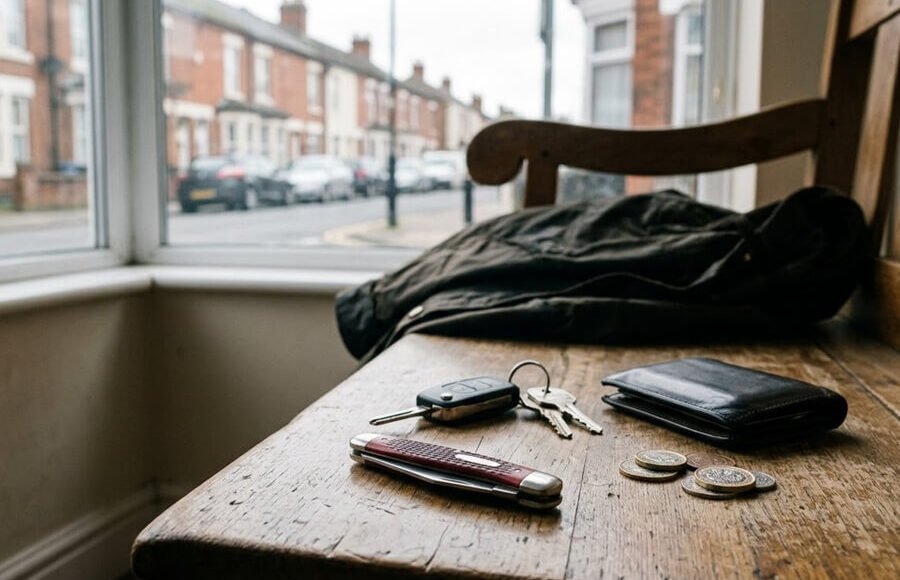
The knife must be a true folding knife. The Court of Appeal held in R v Giles [2003] EWCA Crim 1287 that a lock knife is not a folding pocket knife, because it cannot be folded immediately at all times and needs a further step, such as pressing a button, before it closes. That followed an earlier case, R v Deegan [1998]. A locking knife is therefore treated like a fixed blade, and Giles also failed on the blade length. Police guidance on the point is the same: a lock knife is not an offensive weapon in itself, but having one in public without good reason is still an offence.
The cutting edge must be 3 inches or less. The statute refers to the cutting edge of the blade, not the knife’s overall length. Police guidance says the cutting edge means the whole sharpened side of the blade, including any serrated part. Measure from the point to where the sharpened edge ends at the handle, not the handle or the spine.
What Counts as a Good Reason?
Giles also shows how narrow “good reason” is. The court said you must show a specific reason for having the knife in a public place at that time. It is not enough that you might find a bottle opener or corkscrew on a multi-tool useful, and forgetting the knife was in your pocket does not count.
GOV.UK’s examples of a good reason include taking knives to and from work, taking them to a museum or gallery, using them in theatre, film, TV or historical re-enactment, and religious reasons such as carrying a kirpan. Police guidance adds that a backpacker in the Lake District may need a knife for meals, but the same reason is harder to justify in a town or city, and that attending a scout meeting or martial arts class can be a reason that is easy to check.
What helps in practice is a reason that fits where you are and what you are doing:
- Travelling to or from a job that needs the knife
- On a camping or bushcraft trip, not on the way home from the pub
- Wearing a sgian-dubh as part of Highland dress
- Taking a new knife home from the shop
Can You Carry a Knife for Self-Defence?
No, you should not rely on it. Police guidance warns that carrying a knife with the intent to use it as a weapon, even in self-defence, can lead to arrest, a criminal record and a prison sentence of up to 4 years. A reason that amounts to “just in case” is unlikely to be accepted as specific.
The Law in Scotland
Scotland has its own version in section 49 of the Criminal Law (Consolidation) (Scotland) Act 1995. The structure is the same: it is an offence to have a bladed or sharply pointed article in a public place, except a folding pocket knife with a cutting edge of 3 inches or less.
The differences are:
- The defence is “reasonable excuse” or lawful authority, rather than “good reason”
- The maximum sentence is higher: up to 12 months on summary conviction and up to 5 years on indictment
- The court can order the knife to be forfeited
Northern Ireland
Northern Ireland has its own legislation. NI Direct says the maximum sentence for carrying a knife illegally is 4 years in prison and an unlimited fine, and that you need a good reason to carry a knife or offensive weapon in a public place. Check the current rules with the PSNI before you travel there with a knife.
Knives that are Banned Outright
Some knives are banned whatever their blade length and whatever your reason for having them. These include flick knives, butterfly knives, gravity knives, disguised knives, sword sticks and zombie knives. Police guidance notes that since 2021 it is an offence to possess certain items, including zombie knives and knuckledusters, even in your own home. The zombie knife definition was widened on 24 August 2024, so check GOV.UK before you buy any large, decorative or serrated knife.
Stop and Search
Police can stop and search a person or vehicle if they suspect an offence, including carrying a knife or offensive weapon. If an officer finds a knife, the questions that follow are what type it is, how long the cutting edge is, and what reason you can give for having it. Keep the knife where it is easy to show, in a bag or a box, not loose in a pocket. Once the Crime and Policing Act 2026 knife measures are in force, police will also be able to seize legally held knives they suspect will be used in unlawful violence, but only when they are already lawfully on the premises.
Buying and Age Limits
You must be 18 or over to buy a knife, and it is an offence to sell one to anyone under 18, including kitchen knives. The same 18 age limit applies to buying a crossbow, although crossbow laws are otherwise quite different. NI Direct says anyone over 10 can be charged with carrying an illegal knife, even on a first stop.
The Crime and Policing Act 2026 raises the maximum penalty for selling a knife to an under-18 from 6 months to 2 years, and adds stronger age checks for online and delivery sales. The Home Office factsheet exempts non-locking folding pocket knives with a cutting edge of 3 inches or less from the new online sale requirements. The factsheet is mostly written in the future tense, and the bulk-sales reporting measure needs further regulations, so check GOV.UK for what is in force.
The Act does not change the basic rule on carrying a pocket knife in public. The new offence of having a knife or offensive weapon with intent to use unlawful violence applies only where that intent exists.
Common Mistakes
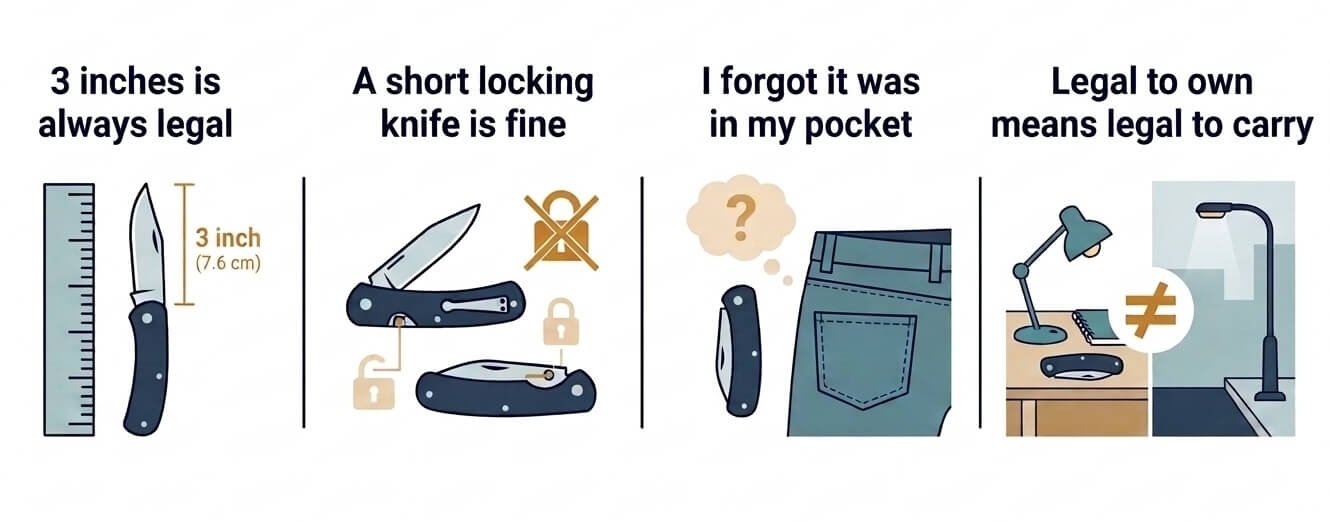
“3 inches is the legal length.” It is an exception for non-locking folding knives, not a blanket allowance for any short blade.
“A short lock knife is fine.” It is not. A lock knife is not a folding pocket knife, so the exception does not apply.
“I forgot it was in my pocket.” Forgetfulness is not a good reason.
“It is legal to own, so it is legal to carry.” Owning a knife at home is lawful for most knives. The carrying rules apply to public places. Air guns work the same way: a low-powered one needs no licence in England and Wales, but carrying it in public without a reasonable excuse is still an offence under air gun law.
Questions People Ask
It depends on the model. If every blade is non-locking and has a cutting edge of 3 inches or less, it is within the exception. If any blade locks open, or any blade is longer than 3 inches, I would need a good reason to have it with me in public.
Only with a good reason. The Court of Appeal has held that a lock knife is not a folding pocket knife, so the 3 inch exception does not apply, even if the blade is short.
I should treat my car as a public place and carry any knife that is outside the 3 inch rule only with a good reason. Putting the knife in a bag or boot and taking it straight to where I will use it makes that reason easier to show.
No, I should not rely on it. Self-defence is not a safe reason, and carrying a knife as a weapon can lead to arrest and up to 4 years in prison.
In England and Wales, up to 4 years in prison on conviction on indictment, and up to 6 months on summary conviction. In Scotland, up to 5 years on indictment and up to 12 months on summary conviction. NI Direct gives 4 years for Northern Ireland.