

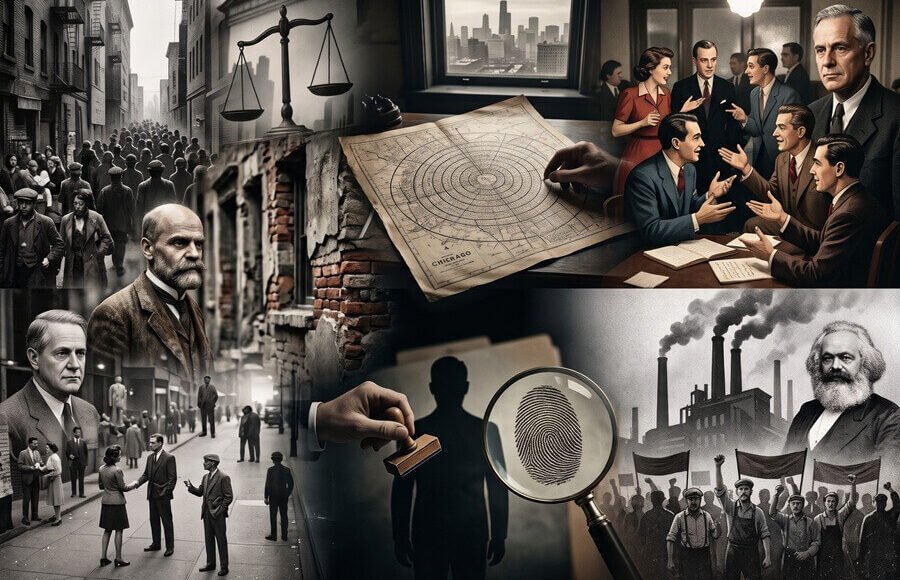
A sociological theory of crime explains why crime happens by looking at society, not at the individual. Instead of asking what is wrong with a particular offender, sociologists ask how things like inequality, neighbourhood, peer groups, family bonds and the way society labels people make crime more or less likely. There is no single sociological theory of crime. There are several, and they often disagree.
What is the Sociological Theory of Crime?
Crime can be explained in different ways. Biological theories look at the body. Psychological theories look at the mind and personality. Sociological theories look at the social world around a person.
Two points help to keep it clear:
- A crime is whatever the law says it is. Sociologists often study how those definitions are made, and who gets labelled as a criminal.
- “Deviance” is a wider word. It covers behaviour that breaks social norms, whether or not it is against the law.
Sociological Theories of Crime
| Theory | Key thinker | Core idea |
|---|---|---|
| Functionalism | Émile Durkheim (1895) | Crime is normal in every society and can have a social function |
| Strain theory | Robert Merton (1938) | Crime comes from a gap between society’s goals and the means to reach them |
| Social disorganisation | Shaw and McKay (1942) | Crime clusters in neighbourhoods where community ties are weak |
| Differential association | Edwin Sutherland (1939) | Crime is learned through contact with people who favour it |
| Subcultural theory | Albert Cohen (1955), Cloward and Ohlin (1960) | Groups form their own values when legitimate routes are blocked |
| Control theory | Travis Hirschi (1969) | People conform because of social bonds, so weak bonds free them to offend |
| Labelling theory | Howard Becker (1963) | Deviance is created when society applies the label |
| Marxist and conflict theory | Taylor, Walton and Young (1973) | Law and crime reflect power and class |
| Realist theories | Wilson (right), Lea and Young (left) | Take street crime seriously, but disagree on causes and cures |
Functionalism: Durkheim
Émile Durkheim argued in The Rules of Sociological Method (1895) that crime is normal in every society. Because it exists everywhere, he said, it cannot simply be a sign of a sick society. He also argued it can serve a purpose: punishment reminds people of shared values, and some acts of rule-breaking can signal that a law needs to change.
Durkheim also used the word anomie for a state where norms break down or weaken. That idea shaped later strain theory.
Strain Theory: Merton
Robert Merton’s 1938 article “Social Structure and Anomie”, in the American Sociological Review, argued that crime can come from strain. Society sets goals, such as financial success, but not everyone has the approved means to reach them.
Merton described five responses:
Conformity. Accept both the goals and the approved means.
Innovation. Accept the goals but use unapproved means, such as theft or drug dealing.
Ritualism. Give up the goal but keep following the approved means.
Retreatism. Reject both the goals and the means and withdraw, for example into substance abuse.
Rebellion. Reject both and try to replace them with new goals and means.
Critics say strain theory is mainly about lower-class crime, does not explain white-collar crime, and assumes strain causes crime when many strained people never offend. Robert Agnew’s general strain theory (1992) later widened the idea to other sources of strain.
The Chicago School, Differential Association and Subcultures
Social disorganisation. Clifford Shaw and Henry McKay studied Chicago neighbourhoods and linked high crime to areas with unstable communities and weak ties between residents.
Differential association. Edwin Sutherland argued that crime is learned, in the same way as any other behaviour, through close contact with people who view it favourably.
Subcultural theories. Albert Cohen’s Delinquent Boys (1955) argued that young people who are shut out of success by the usual route may build a group with its own values. Cloward and Ohlin’s Delinquency and Opportunity (1960) added that illegitimate routes to success are also unequally available.
Social Control Theory: Hirschi
Most theories ask why people offend. Travis Hirschi’s control theory, set out in Causes of Delinquency (1969), turns the question around and asks why most people do not. His answer is social bonds: attachment to others, commitment to goals, involvement in conventional activities and belief in shared rules. When those bonds are weak, he argued, people are freer to break the law.
Labelling Theory: Becker
Howard Becker’s Outsiders (1963) argued that deviance is not just a quality of an act. It is created when society applies rules and labels people who break them. Labelling theory is less interested in why someone first breaks a rule and more interested in what happens next, because being labelled a criminal can shape how others treat you and how you see yourself.
A related idea is the moral panic. In Folk Devils and Moral Panics (1972), Stan Cohen studied clashes between mods and rockers at English seaside resorts. He argued that media coverage built a clear villain, the “folk devil”, and that the exaggerated reaction helped to fuel the very behaviour it condemned.
Conflict and Marxist Theories
Conflict theories say that law is shaped by those with power. In Britain, the best known statement is The New Criminology by Ian Taylor, Paul Walton and Jock Young (1973), which approached crime through class and power, and asked who makes the laws and whose behaviour they target.
A common criticism is that these approaches say less about ordinary street crime and its victims. That criticism helped to drive the next group.
Realist Theories
Right realism. Associated with James Q. Wilson, this approach focuses on order and on practical ways to reduce crime. The “broken windows” idea, put forward by Wilson and George Kelling in 1982, argued that visible disorder left unchecked can signal that nobody cares and invite more serious crime.
Left realism. John Lea and Jock Young’s work in the 1980s accepted that street crime is a real problem, particularly for working-class communities, while still linking it to inequality and to how policing is experienced.
Criticisms of Sociological Theories
Sociological theories are better at explaining patterns across society than at explaining why one person offends and another does not. No single theory explains every kind of crime, which is why many writers combine them. Strain theory struggles with white-collar crime, and Marxist approaches can say less about crimes between individuals. Many of the classic theories also come from the United States, so they need care when applied to the UK.
How these Ideas Show Up in UK Law and Policy?
Theories are not law, but they sit behind debates that affect real people.
Labelling and rehabilitation. The Rehabilitation of Offenders Act 1974 lets most cautions and many convictions become “spent” after a set period, so that a person is treated as rehabilitated and does not usually have to declare it. According to the Ministry of Justice guidance, the Act “primarily exists to support the rehabilitation into employment of those with convictions who have ceased offending”. That reflects the labelling concern that a record can keep following someone.
Disorder and anti-social behaviour. Anti-social behaviour orders were introduced under the Crime and Disorder Act 1998 and were replaced in 2014 by civil injunctions and criminal behaviour orders under the Anti-social Behaviour, Crime and Policing Act 2014. Debates about when and how to respond to low-level disorder echo the broken windows argument.
Knife crime. The theories give different readings of why someone carries a knife. A strain reading looks at blocked opportunity, a control reading at weak bonds, a labelling reading at how a young person is treated after a first stop or conviction, and a realist reading at policing and victims. The legal position on carrying a pocket knife in public does not depend on any of them, since the offence is set by statute.
Common Questions
It is the idea that crime is shaped by social conditions, such as inequality, neighbourhood, peer groups and how society labels people, and not only by an individual’s choices or character.
Psychological theories look at the individual, such as personality or thinking. Sociological theories look at the wider social setting. In practice I find the two work best together, because a social explanation cannot say why one person offends and another does not.
None is. Each explains some patterns and leaves others unexplained, which is why many writers draw on several theories together.
Robert Merton’s theory that crime can arise when society sets goals, such as financial success, but not everyone has approved ways to reach them. He described five responses: conformity, innovation, ritualism, retreatism and rebellion.
Howard Becker’s idea that deviance is created when society applies the label. It asks what happens after someone is labelled, and how that label can affect their later behaviour.